Most petrol pump and CNG station owners in Lahore can tell you exactly how many litres they sold yesterday. Ask them about their security plan, and the answer is usually a shrug and a nod toward the watchman who’s been sitting on that stool since the station opened.
That gap is worth taking seriously. Fuel stations sit on busy roads in plain view, stay open around the clock, and handle more cash on a slow day than most retail shops see in a week. Yet when business owners think about security, they picture offices, warehouses, and gated homes — not the pump on the corner. That blind spot is exactly what this post is about.
Why a Petrol Pump Isn’t Just Another Retail Property
A shop can pull its shutter down at closing time. A petrol pump can’t. The forecourt stays open, lit, and accessible to anyone who drives up — which is the whole point of the business, but it’s also what makes these sites harder to secure than a shop with four walls and a lock.
Add to that a filling station usually has cash in hand at almost every hour it’s open, several entry and exit points with no real barrier between them, and staff who are focused on customers and fuel dispensing rather than watching who’s walking around the property. None of this is unique to Lahore — it’s the nature of the business anywhere — but it does mean the standard “post a guard at the gate” approach used for offices and housing societies doesn’t translate directly to a fuel station.
The Cash Problem Most Owners Underestimate
Fuel in Pakistan is still largely a cash business. Every litre sold adds to a growing amount sitting in the cash office through the day, and that cash has to move: to a bank, to a cash-in-transit pickup, or simply into a safe at shift’s end. That movement is the moment robbers actually plan around. A robbery rarely happens at a random hour; it happens when someone has watched the pattern for a few days and knows roughly when the till is fullest and the fewest people are around to react.
Recent cases reported around the country have followed a similar shape: armed men arriving on a motorcycle or in a car, catching staff off guard during a quiet stretch, and leaving within minutes with the day’s collection. In at least one widely reported case, the security guard on duty was the first person overpowered — his own weapon taken before he could use it. That detail matters, because it says something important: having a guard on site is not the same as having a security plan.
Night Shifts and the Highway Problem
A large share of petrol pumps and CNG stations in and around Lahore run 24 hours, and the risk profile after midnight looks nothing like it does at 6 pm. Traffic thins out, there are usually only one or two staff on the forecourt, and if the station sits along a highway stretch — the GT Road or a motorway — the nearest police response can be a real drive away, not a quick radio call.
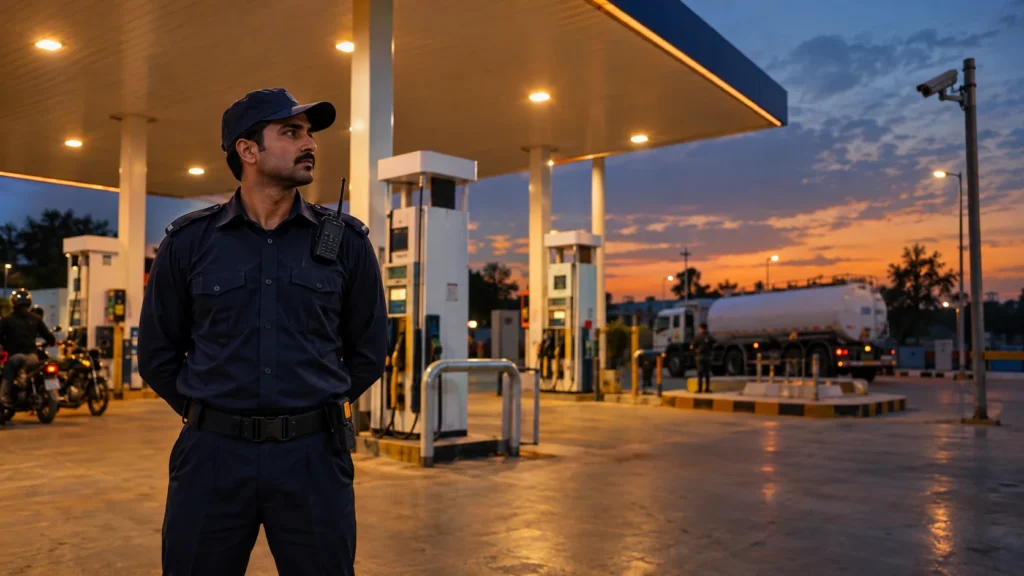
This is where the type of guard matters as much as whether a guard is present at all. A single unarmed watchman on a long shift, expected to also help customers and keep an eye on the pumps, isn’t in much of a position to do anything if two or three armed men pull in at 2 am. Matching a guard’s training and equipment to the actual hours and location of the station is one of the most overlooked parts of fuel station security.
When Fuel Shortage Rumors Turn a Forecourt Into a Flashpoint
There’s a risk specific to this industry that offices and shops don’t really face: panic. When news breaks of a possible fuel shortage, a price hike, or a supply disruption, queues at petrol pumps can grow long and tense within the hour. People start filling extra cans, arguments break out over turns, and staff end up caught in the middle of disputes they didn’t create. Punjab has already seen this kind of situation turn into gunfire between customers, not criminals — a reminder that crowd control at a fuel station is a security function too, not just a customer service problem.
A trained guard who knows how to manage a queue, calm an argument before it escalates, and recognize when a situation needs a call to police is worth far more in these moments than an extra camera pointed at an already-tense forecourt.
Don’t Forget What’s Happening Behind the Pumps
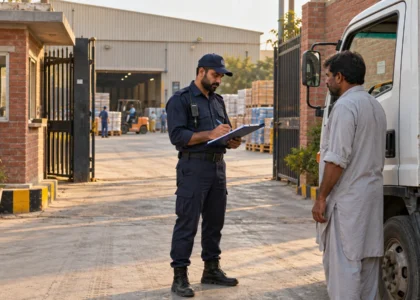
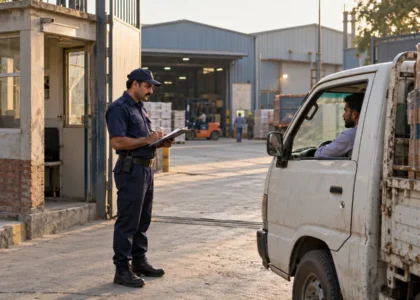
Robbery gets the headlines, but a fair share of loss at fuel stations happens quietly, from the inside. Short-filling customers, tampering with dispensing meters, and skimming fuel during tanker offloading are ongoing problems that cost owners money every month without a single dramatic incident ever occurring. CNG stations carry an added risk once the compressors shut down for the night — copper wiring and metal fittings around the equipment yard are a known target for scrap theft when no one’s watching that side of the property. The tanker delivery window itself is another exposed moment, since it involves outside drivers, open access points, and paperwork that’s easy to rush through without anyone properly checking it.
A security presence that only watches for outsiders misses half the job. Supervision during deliveries, shift handovers, and cash counts protects a station from losses that never show up as a “robbery” in any police report.
What Real Security Looks Like for a Fuel Station
None of this means every pump needs a small army standing guard. It means the security plan should be built around how the station actually operates, not copied from a generic checklist. In practice, that usually comes down to a few things:
- Armed guards for stations handling significant daily cash or sitting in isolated or highway locations, unarmed guards where the risk is genuinely lower
- CCTV coverage that a guard actively monitors and responds to, not just a camera recording footage nobody watches until after something has already gone wrong
- A fixed but varied procedure for cash pickups and bank runs, so the timing isn’t predictable to anyone watching from outside
- Supervised shift changes, so there’s never a gap where the forecourt is effectively unguarded
- A guard briefed and present during tanker delivery hours, actually paying attention while offloading happens
- Lighting and access checks around the edges of the property, not just the pump islands — the areas someone would actually use to approach unseen
This looks closer to how banks and industrial sites are protected than how a typical retail shop is guarded, and that’s the point — a fuel station has more in common with those environments than most owners assume.
Getting This Right
Petrol pump and CNG station owners already spend real time and money on fire safety, equipment maintenance, and OGRA compliance — as they should. Security tends to get whatever’s left over: a single guard hired out of habit rather than planning. Given what’s actually at stake day to day, that’s the part of the business most worth a second look.
As a security guard company already working with commercial and industrial sites across Lahore, Bulwark Security & Management Pakistan can assess a specific station before recommending what level of coverage it actually needs. Get in touch with our team for a site visit and a straight answer — not a standard package sold to every client.