
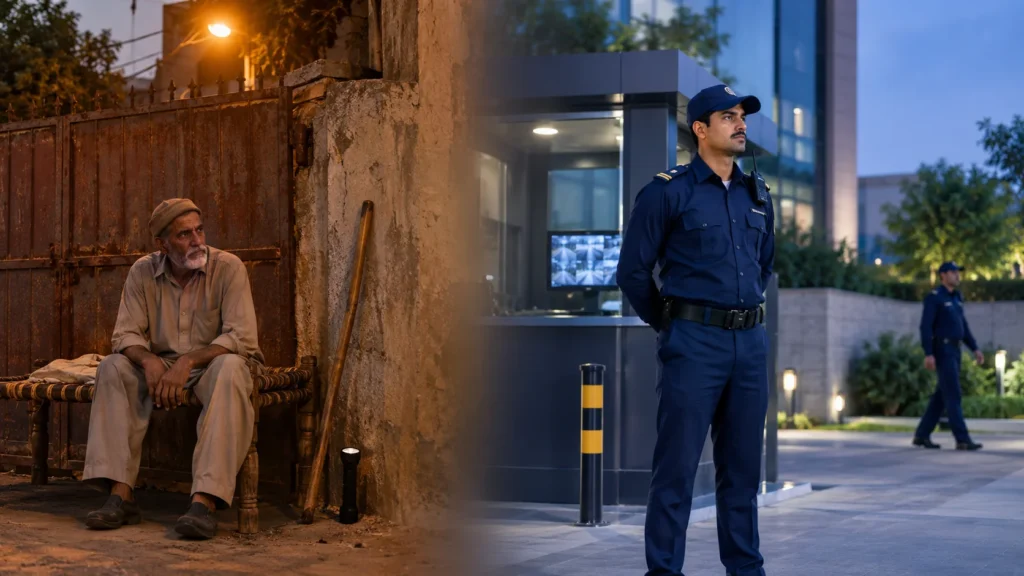
Ask any shopkeeper on a busy Lahore market road how he keeps his property safe at night, and there’s a good chance he’ll point to an older man sitting on a charpai near the gate, a torch in one hand and a lathi resting against the wall. Ask a factory manager the same question, and he’ll usually describe something different: guards in uniform, a supervisor who checks in during the night, a number he can call the moment something feels off. Both men would tell you, honestly, that they’ve hired “a guard.” But they aren’t paying for the same thing at all, and most owners only find out how different these two options are after something has already gone wrong.
This private watchman vs security company decision comes up constantly among shop owners, factory managers, and even families trying to secure a home in Lahore. On paper, a private watchman, or chowkidar, as he’s usually called, looks like the simpler, cheaper choice. A security company can look like an unnecessary expense for what seems like the same job. That impression rarely survives a closer look, because the invoice only tells you half the story.
A Watchman and a Security Guard Are Not the Same Job
The two terms get used interchangeably, but they describe different arrangements.
A private watchman is usually one individual, hired directly, often through a personal reference, a relative’s suggestion, or someone who simply showed up looking for work. He’s on his own. There is no company behind him, no formal training record, and no one supervising his shift besides you.
A security guard supplied by a company like Bulwark Security & Management Pakistan is part of a larger structure. He still stands at your gate, but behind him sits a recruitment process, a training record, a duty roster, a supervisor who does rounds, and a company that is legally answerable for how he performs.
This isn’t a comment on character. Plenty of private watchmen are honest, alert, and genuinely good at their job. The difference is not the man, it’s what stands behind him when he’s sick, when something goes wrong, or when your property needs more coverage than one tired person can reasonably provide alone.
What You Get When You Hire a Watchman Directly
Hiring someone yourself has an obvious appeal. It feels personal, it’s usually cheaper month to month, and you deal with one man instead of a company. But this arrangement also has limits that rarely show up until you actually need them not to exist.
A few things worth keeping in mind:
- He is one person, with no backup. If he falls ill, needs to attend a wedding back home, or simply does not show up one night, your property has no coverage until you sort it out yourself.
- Verification is usually informal. Most private hires are based on a reference or a gut feeling, not a documented background check against his CNIC or police record.
- There’s no real training behind him. Patrol routine, basic fire response, how to handle a visitor who won’t leave, none of it is standardized. Whatever he knows, he picked up on the job, somewhere else, or nowhere at all.
- Supervision is entirely on you. If you want to know whether he actually did his rounds at 2 a.m., you have to check yourself. There is no log, no patrol record, no second set of eyes.
- You carry the liability. If something happens on your property and negligence is involved, there’s no company insurance policy standing between you and the consequences.
- He can leave with no notice. A better offer, a family matter, a disagreement over pay, and you’re back to searching, usually in a hurry.
None of this makes a private watchman a poor choice for every situation. It simply means the lower monthly cost buys you exactly one thing, a person at your gate. Everything else, backup, training, accountability, is on you to arrange yourself, if you arrange it at all.
What You’re Actually Paying For With a Security Company
This is where the price difference starts to make sense. When you hire a professional security company, the guard standing at your gate is only the visible part of what you are paying for.
Screening that goes beyond a reference. Reputable companies verify CNIC details, check police character certificates, and confirm past employment before anyone gets deployed. You aren’t relying on someone’s word alone.
Actual training. Guards go through instruction on patrol procedure, access control, basic fire and emergency response, and how to deal with the public professionally. It isn’t perfect everywhere, but it is a standard, not a guess.
Supervision that doesn’t depend on you checking. A field supervisor or patrol officer visits sites, reviews logs, and holds guards accountable, so you are not the only person making sure the job actually gets done.
Legal standing. Private security companies operate under licenses issued by the provincial Home Department. That requirement, and the compliance it forces on the company, is exactly what an individually hired watchman typically has no obligation to meet.
Guaranteed coverage. If your guard is sick, on leave, or simply doesn’t turn up, a company sends a replacement. Your gate isn’t left open because one man had a bad day.
A chain of command, not a single phone number. When something happens at three in the morning, you are not hoping one tired man makes the right call on his own. There’s a duty officer, a supervisor, sometimes a control room, standing behind him.
Some form of accountability if things go wrong. Whether that is insurance, a formal complaint process, or simply a company with a reputation to protect, there is a structure you can hold responsible, not just one individual with nothing to lose.
Put simply, a watchman sells you his presence. A security company sells you a system built to keep working even when one person can’t.
The Price Tag Doesn’t Tell the Whole Story
It’s true that hiring a private watchman usually costs less, month to month, than contracting a security company. That is a fair comparison to make, and pretending otherwise would not be honest.
What doesn’t show up on that lower invoice is everything that happens around it. Picture a small warehouse on the outskirts of Lahore. Stock goes missing over a few weeks. The watchman says he stepped away briefly, or that he must have dozed off near dawn. There is no CCTV log to check against, no patrol record, no supervisor who can confirm what actually happened that night. The owner is left with a guess, a strained relationship with someone he trusted, and no real way to recover the loss.
Now picture the same warehouse with a contracted guard instead. There’s a patrol log with timestamps. A supervisor who can be questioned about the midnight site visit. A company that, depending on the contract, carries some responsibility for what happened on watch. The cost gap between the two setups starts to look a lot smaller once you weigh what one option protects you from and the other simply doesn’t.
This isn’t an argument that a security company is always worth it, regardless of the situation. It’s an argument for knowing exactly what you’re comparing before a number at the bottom of a quote makes the decision for you.
When a Lone Watchman Might Genuinely Be Enough
To be fair, a private watchman isn’t the wrong answer for everyone. A small home in a quiet, low risk neighborhood, with a single gate, a tight budget, and a family that’s usually around and knows the man personally, is a reasonable situation for a direct hire. The relationship is close enough that a lot of the accountability gap gets filled informally, through trust built over time.
Where the calculation changes is anywhere the stakes go up: a commercial property, a factory holding valuable stock, a wedding hall responsible for hundreds of guests on a given night, a school, a plaza with several shops and tenants under one roof. Anywhere you’re responsible for other people’s safety, not just your own belongings, the gap between “a person at the gate” and “a supervised, accountable system” starts to matter a great deal more.
Questions Worth Asking Before You Decide
Whichever way you’re leaning, run through this short checklist before you commit to either option.
- Is the person or company actually licensed to operate, and can they prove it?
- If my guard doesn’t show up, who do I call, and what happens next?
- Is there a real backup plan if he’s sick or on leave, or am I covering that gap myself?
- What kind of verification did this person actually go through before I hired him?
- If something goes wrong on my property, who is responsible, legally and practically?
- Does anyone besides me actually supervise this person’s shift?
If you can’t answer most of these confidently about a private hire, that gap is worth pricing into your decision, even if it never shows up on an invoice.
Why More Businesses in Lahore Are Moving Toward Licensed Security Companies
Provincial regulation of private security in Pakistan has been tightening rather than loosening over the past several years, with Home Departments taking licensing, verification, and standard operating procedures more seriously than before. At the same time, more businesses, from retail outlets to gated housing societies to corporate offices, are expected by their own customers, tenants, or insurers to show visible, accountable security arrangements, not just a man standing at a gate.
That shift is part of why a company like BSM Pakistan exists in the first place, to give property owners in Lahore a way to meet that expectation without building their own recruitment, training, and supervision system from the ground up. It’s the difference between hiring a person and hiring a service that a person happens to deliver.
Frequently Asked Questions
Is it legal to hire a private watchman directly in Lahore instead of going through a company?
Generally, yes, for a private home or small personal property, hiring someone directly is common practice. The licensing requirements mainly apply to companies operating as security service providers, not individuals guarding their own family’s home. Rules do get updated though, so it’s worth confirming current requirements if you’re unsure, especially for a commercial property.
How much more expensive is a security company compared to a private watchman?
It varies by city, guard type, and shift structure, so there isn’t one number that applies everywhere. What stays consistent is why the gap exists, a company’s fee covers training, supervision, licensing compliance, and replacement coverage, not just one person’s monthly wage.
What happens if my guard doesn’t show up for duty?
With a direct hire, that’s your problem to solve, usually on short notice. With a licensed security company, replacement coverage is typically built into the service, so your property isn’t left unguarded because one person is unwell or unavailable.
Can a security company provide armed guards if I need them?
Yes, licensed companies can generally provide both armed and unarmed guards, matched to your property’s actual risk level. This usually gets worked out during an initial site assessment rather than decided upfront, since not every property needs the same level of coverage.
Talk to Someone Before You Decide
Whichever direction feels right for your property, the decision shouldn’t come down to guesswork. If you’d like a straightforward assessment of what your home, shop, or business in Lahore actually needs, and an honest answer about whether that’s a single guard or something more structured, our team is glad to walk through it with you.
Contact BSM Pakistan to talk about what your property actually needs, and what it would take to get it right.