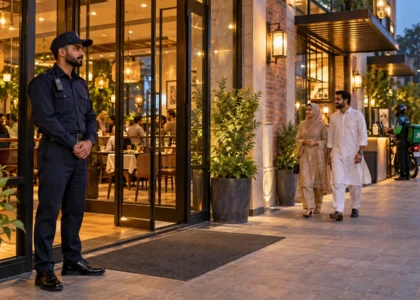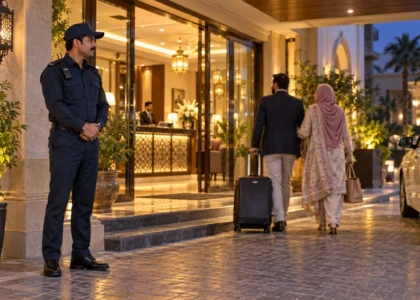

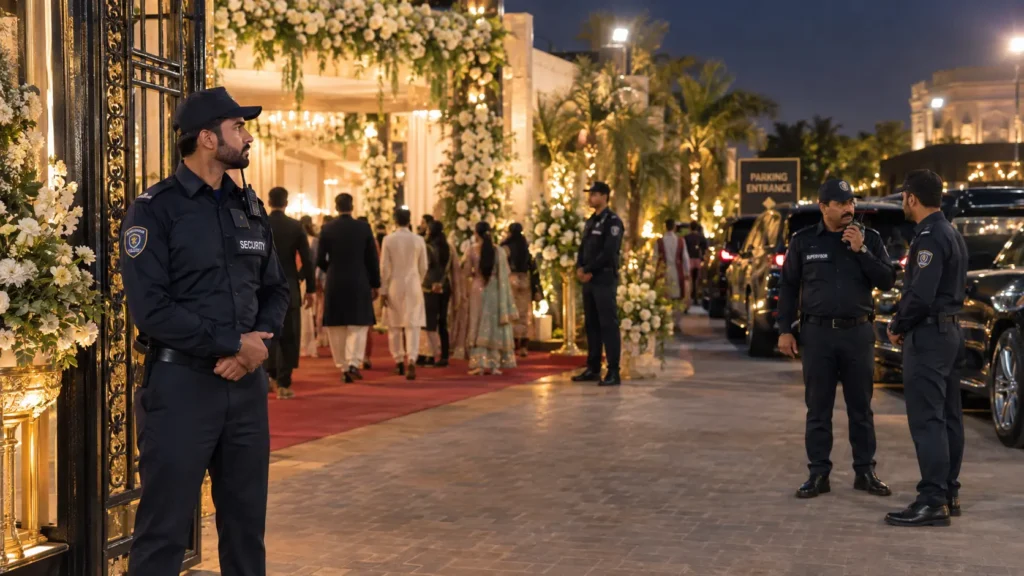
Large weddings look beautiful when everything is under control. Guests arrive, cars move in and out, vendors stay in their assigned areas, the main entrance remains organized and the family can focus on the celebration.
Behind that smooth experience, someone has to manage security.
A small family gathering may only need basic entrance monitoring. A large wedding with hundreds of guests is different. There may be several entry points, heavy traffic outside the venue, separate areas for families and staff, expensive equipment, valuable belongings, VIP guests and large numbers of people arriving at the same time.
That raises a practical question for families, wedding planners and venue managers: how many security guards do you actually need for a large wedding?
There is no single number that works for every wedding. Guest count matters, but it is only one part of the calculation. A proper wedding security plan looks at the venue, access points, parking area, guest movement, event timings, VIP requirements and potential risks before deciding how many personnel are needed.
A Simple Starting Point for Wedding Security Staffing
Industry event security guidance commonly uses a rough guard to guest ratio as an initial planning reference. Some current guidance places lower risk events around one guard per 75 to 100 attendees, while more demanding events can move toward one guard per 50 attendees or lower depending on the circumstances. These figures are planning benchmarks, not a universal standard.
For a wedding, that can give you an initial idea:
| Expected Guests | Rough Starting Range |
|---|---|
| 100 guests | 2 to 3 guards |
| 250 guests | 3 to 5 guards |
| 500 guests | 5 to 10 guards |
| 750 guests | 8 to 12 guards |
| 1,000 guests | 10 to 15 guards |
These numbers should not be treated as the final deployment.
For example, a 500 guest wedding held inside one controlled hall with one main entrance is very different from a 500 guest wedding spread across a marquee, parking area, multiple gates and separate family spaces.
The second event may need more personnel even though the guest count is identical.
That is why professional security planning starts with the actual venue rather than simply dividing the guest list by a fixed number.
Guest Count Is Only the First Calculation
The number of people attending gives you a rough starting point, but security personnel are not standing in one large room watching everyone.
They have specific responsibilities.
One guard may be managing the main entrance. Another may be assigned to a secondary gate. Someone else may monitor the parking area while another officer patrols the venue. A separate guard may be needed near a restricted family area or VIP entrance.
As the wedding becomes larger, these fixed positions quickly increase the manpower requirement.
This is where a simple guest ratio can become misleading.
A 700 guest wedding does not necessarily need seven guards simply because someone calculated one guard per 100 guests. Seven people cannot effectively cover several entrances, parking, the main hall, restricted areas and mobile patrol duties at the same time.
The better question is:
How many security positions need to be covered at the same time?
Count the Entry Points First
Large weddings often have more than one way into the venue.
There may be:
- Main guest entrance
- Family or VIP entrance
- Staff and vendor entrance
- Service or catering access
- Parking access
- Emergency access
Every active entrance creates a security responsibility.
A guard assigned to the main entrance should not be expected to leave that position repeatedly to check the parking area. This creates gaps in coverage.
For a wedding with multiple entrances, the staffing plan should account for those locations separately.
Access control can include checking invitations or guest lists, monitoring unauthorized entry, directing visitors and watching for unusual activity. BSM Pakistan lists event security and access management related duties among its security services.
Parking Security Is Easy to Forget
The security plan should not stop at the venue doors.
Large weddings can bring dozens or even hundreds of vehicles to one location within a short period. Guests may arrive at the same time, drivers may need direction and vehicles can create congestion around the entrance.
Parking areas also need monitoring, especially when the event is held at a large marquee, farmhouse, wedding hall or open venue.
Depending on the layout, security personnel may be needed to:
Monitor vehicle movement
Guide arrivals toward designated parking
Watch entry and exit points
Prevent unauthorized vehicles from entering restricted areas
Keep pedestrian movement separate from vehicle traffic
Respond to problems outside the main venue
Parking coverage becomes especially important when the main hall is far from the vehicle area.
VIP Guests Require Separate Planning
Some weddings include senior business figures, public personalities, influential families or other guests who require additional privacy and protection.
In those situations, general event security and VIP protection should not necessarily be treated as the same job.
A guard managing an entrance has a different responsibility from a person assigned to protect and accompany a particular guest.
VIP security can involve:
Controlled arrival and departure
Secure movement through the venue
Restricted access around private areas
Vehicle coordination
Dedicated protection personnel
A wedding with important guests may therefore require additional personnel beyond the basic crowd management team.
BSM Pakistan also lists VIP and personal security as part of its security solutions.
Think About the Wedding Layout
Venue design can change the security requirement significantly.
Consider two weddings with 500 guests.
The first takes place inside one enclosed hall with a single entrance and clearly defined parking.
The second takes place at a large farmhouse with multiple gates, an outdoor lawn, separate dining space, parking several hundred metres away and vendor access at the rear.
The guest count is the same.
The security workload is not.
A larger footprint means guards are spread further apart, and response times can become longer when there are too few mobile personnel.
Before finalizing the staffing number, the security team should review:
Venue boundaries
Number of gates
Indoor and outdoor areas
Parking locations
Vendor access
Restricted areas
Emergency exits
Guest flow
Crowded points
This type of site assessment is consistent with event security planning frameworks that consider venue characteristics and crowd management instead of relying only on attendance figures.
Consider When Guests Will Arrive
The busiest period of a wedding may not be the middle of the event.
Guest arrival can create a short but intense period where hundreds of people and vehicles reach the venue close together.
That is when entrance queues, parking congestion, guest verification and vehicle movement all happen at once.
For this reason, security staffing should consider different phases of the event.
Before Guests Arrive
The team can inspect entrances, secure restricted areas, check the perimeter and coordinate with the venue and event management staff.
Guest Arrival
More attention may be required at gates, parking and guest access points because activity is concentrated within a short period.
During the Wedding
Some guards remain at fixed posts while others monitor guest movement, restricted areas and the surrounding venue.
Guest Departure
The security requirement does not automatically end when dinner is over. Vehicle movement, crowd dispersal and VIP departures may need additional attention.
This phased approach can make the deployment more practical than keeping exactly the same number of personnel at every point of the evening.
Do You Need a Security Supervisor?
For a large wedding, a supervisor can be useful even when the deployment does not appear particularly complicated.
The supervisor can coordinate the team, communicate with the wedding planner or venue management, check guard positions and respond when an issue requires additional manpower.
This becomes more important when security personnel are divided between several areas.
For example, a 1,000 guest wedding may involve guards at the main gate, secondary gate, parking, venue floor, perimeter and VIP area. Someone needs a clear picture of what is happening across all those locations.
Without proper coordination, you can technically have enough guards but still have weak security coverage.
When a Wedding May Need More Security
Several factors can justify increasing the security team beyond the initial guest count estimate.
Large or Open Venue
A large outdoor footprint requires personnel to cover greater distances.
Multiple Entry Points
Each active access point creates another post that needs continuous coverage.
VIP Guests
Dedicated protection may be required for certain individuals.
Large Parking Areas
Vehicles and pedestrian movement may require separate monitoring.
High Guest Turnout
Higher attendance increases movement and crowd density.
Late Night Events
Long events can create additional operational challenges, especially during guest departure.
Valuable Equipment
Sound systems, lighting equipment, generators and other event assets may need monitoring.
Restricted Areas
Family rooms, bridal areas, backstage spaces, kitchens and service entrances can require controlled access.
The more of these factors present at the same wedding, the less useful a simple guest ratio becomes.
How Many Guards Might a 500 Guest Wedding Need?
Let’s take a practical example.
Suppose a 500 guest wedding is being held at a large Lahore venue with two guest entrances, one service entrance, a sizeable parking area and a separate VIP arrival point.
A basic planning exercise might begin with approximately 5 to 10 guards based on common industry starting ranges.
The final team could then be adjusted after looking at the actual venue.
For example, the deployment might include personnel for:
Main entrance
Second entrance
Service entrance
Parking area
Venue floor
Mobile patrol
VIP coverage
Supervisor
That example shows why the final figure can be higher than a simple guest calculation.
The goal is not to put as many guards as possible around the wedding. The goal is to place the right number of trained personnel in the locations where they are actually needed.
Why Hiring Too Few Guards Creates Problems
Understaffing can leave important areas unattended.
A guard may have to leave the entrance to handle an incident in the parking lot. Another may be pulled away from the venue floor to help with a gate problem.
Now the original post is empty.
These gaps are difficult to manage during a busy wedding because events move quickly. Problems can develop in one part of the venue while the available guard is already dealing with another issue.
A proper plan allows the team to maintain fixed positions while still having mobile personnel available for unexpected situations.
More Guards Do Not Automatically Mean Better Security
There is also another side to the calculation.
Adding personnel without a clear deployment plan can create unnecessary cost without solving the actual problem.
Ten guards standing in the wrong places may provide less useful coverage than a smaller team with clearly assigned responsibilities.
That is why professional event security planning focuses on posts, responsibilities, movement and risk instead of simply chasing a high guard count. Current event security guidance makes the same distinction: staffing ratios are useful as starting points, but actual deployment depends on factors such as entrances, layout and risk profile.
A Practical Checklist Before Hiring Wedding Security
Before booking security guards for a large wedding, provide the security company with as much information as possible.
Share the expected guest count.
Provide the venue location and layout.
Explain how many entrances will be open.
Identify parking arrangements.
Mention VIP or high profile guests.
Explain whether there will be separate family or restricted areas.
Share event timings.
Identify vendor and staff entrances.
Mention any previous security concerns.
Explain whether the wedding is indoors, outdoors or a combination of both.
This gives the security provider enough information to build a deployment plan instead of guessing the number of guards from the guest list alone.
Choose Security According to the Event, Not Just the Headcount
A 300 guest wedding can have more security challenges than a 700 guest wedding when the smaller event has multiple gates, a large outdoor area, VIP guests and difficult parking.
That is the key point many wedding planners overlook.
Security planning should begin with risk and venue requirements, then move to guard numbers.
For large weddings, the most useful staffing calculation usually combines guest count with the number of fixed posts, venue size, access points, parking, VIP requirements and the need for mobile response.
BSM Pakistan provides event security services with trained personnel for crowd management, entry points and event flow, along with other security options including armed, unarmed, female, VIP and onsite security services.
Before booking guards, discuss the complete venue and event setup with a professional security provider.
Contact BSM Pakistan to discuss your wedding security requirements and get a deployment plan based on your venue, guest count and event arrangements.
For broader information about BSM Pakistan and its security solutions, visit the BSM Pakistan homepage.
Frequently Asked Questions
How many security guards are needed for a 500 guest wedding?
A rough planning range can start around 5 to 10 guards, but the final number depends on the venue, entrances, parking, VIP requirements, crowd movement and other risks.
Is there a fixed security guard to guest ratio for weddings?
No single ratio works for every wedding. Ratios are generally used as starting points and then adjusted according to the event’s risk and operational requirements.
Should parking have separate security guards?
For a large wedding, dedicated parking coverage may be necessary when the parking area is large, separated from the venue or has significant vehicle movement.
Do VIP wedding guests need separate security?
They may. General event security and personal protection have different responsibilities, so dedicated VIP personnel can be appropriate for high profile guests.
Should a large wedding have a security supervisor?
A supervisor can help coordinate guards across multiple entrances, parking areas, venue zones and VIP locations, particularly when the security team is spread across a large site.
Does BSM Pakistan provide wedding security?
BSM Pakistan lists event security among its services and provides security personnel for crowd management, entry points and event flow.