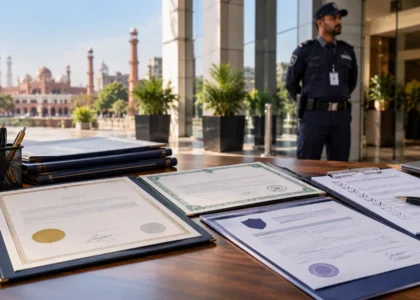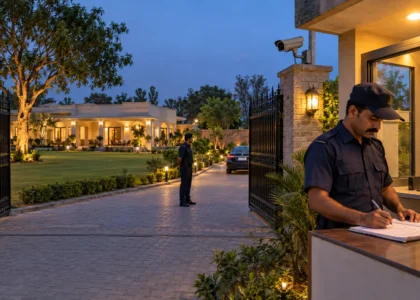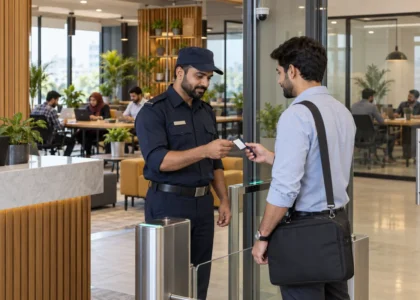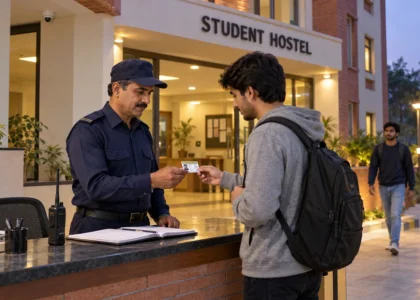

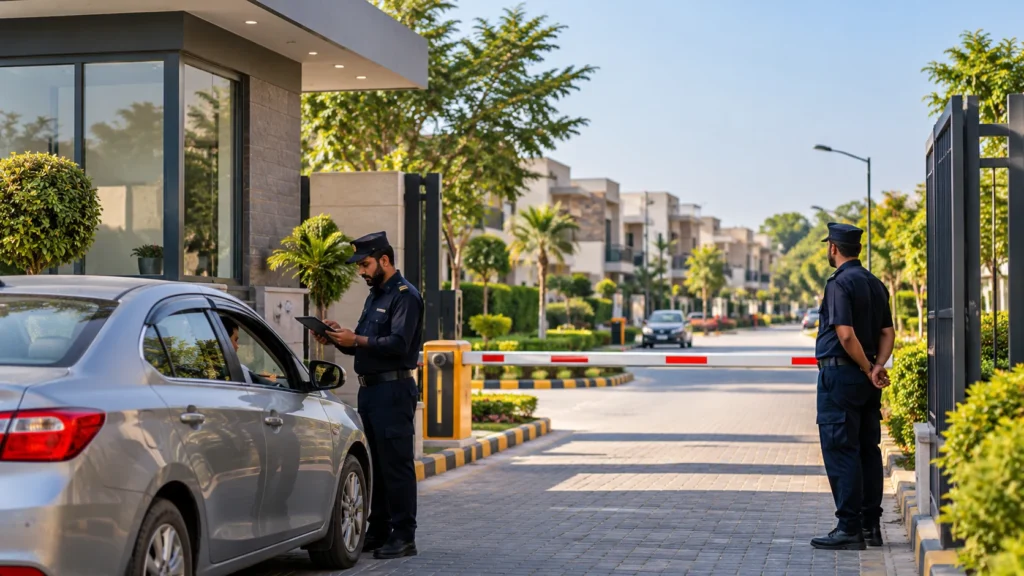
A large residential community has more security challenges than a single house or apartment building. Multiple entrances, hundreds of residents, delivery vehicles, maintenance workers, parking areas and shared facilities all require proper monitoring.
Simply placing security guards at the main entrance is not enough. A community also needs clear visitor procedures, suitable patrol coverage, emergency response arrangements and regular checks of its security systems.
For housing societies in Lahore, where communities can include residential blocks, commercial areas, parks and several entry points, security planning should begin with the property’s actual needs rather than a standard staffing arrangement.
A well prepared residential community security plan helps management identify risks, assign responsibilities and make better decisions about security guards, equipment and operating procedures.
1. Start With a Security Risk Assessment
Before hiring security personnel or installing new equipment, assess the entire community. The purpose is to understand what needs protection, where controls may be weak and which situations require the fastest response.
The assessment should cover the following areas:
-
Main gates and secondary entrances
-
Pedestrian access points and boundary walls
-
Residential streets and parking areas
-
Parks, playgrounds, clubhouses and community halls
-
Commercial areas and shops within the society
-
Maintenance buildings, utility areas and vacant properties
-
Lighting, surveillance equipment and communication systems
Management should also review previous incidents, resident complaints, unauthorised entry attempts and recurring problems reported by guards.
Visit relevant areas at different times of day. A location that appears well monitored in daylight may need better lighting or visibility after dark.
The assessment should end with a prioritised list of risks. For example, a malfunctioning entry barrier may require immediate attention, while improving lighting in a less frequently used area may form part of the next maintenance phase.
This approach allows management to allocate its budget according to actual risks instead of spending money on equipment or additional posts without a clear purpose.
2. Map Every Entrance and Establish Access Control Rules
Access control is one of the most important parts of a residential security plan. The aim is to make sure that residents, visitors, workers and delivery personnel can enter through a clear and consistently managed process.
Start by documenting all vehicle and pedestrian entrances. Decide which gates should remain operational at different times and who is responsible for monitoring each access point.
The community should establish separate procedures for:
Residents: Approved residents should have a convenient way to enter without unnecessary delays. Access cards, vehicle stickers, approved lists or other suitable methods can help identify authorised entry.
Visitors: Guards should follow a consistent process for confirming the purpose of a visit and verifying the relevant resident’s approval when required.
Domestic staff and service providers: Management should define how regular workers, cleaners, drivers, technicians and other service providers are registered and identified.
Delivery personnel: Establish clear instructions for food deliveries, courier parcels, grocery orders and larger deliveries. Decide when a delivery can be received at the gate and when entry into the community is permitted.
Contractors and construction workers: Verify approved work, maintain suitable entry records and establish how tools, materials and vehicles are handled.
Emergency vehicles must have a clearly defined access procedure that avoids unnecessary delays.
It is also important to decide how guards should handle refused entry, incomplete visitor information and disputed authorisations. Clear instructions reduce arguments at the gate and help different shifts follow the same rules.
3. Determine How Many Security Guards the Community Needs
One of the first questions housing society management asks is how many guards should be hired.
There is no reliable number that works for every residential development. Staffing depends on the number of entrances, traffic volumes, property layout, operating hours, risk level, patrol responsibilities and available security technology.
A practical plan considers several types of security posts.
Main entrance security
Main gates usually require personnel to manage vehicle movement, verify entry and deal with visitors. Busy entrances may need separate responsibilities for access verification and traffic flow.
Secondary entrance security
Smaller gates, pedestrian entrances and service entrances should not be overlooked. Their staffing requirements depend on how often they are used and the risks associated with them.
Mobile patrols
Mobile patrols help cover internal roads, parking areas, shared facilities and other locations that cannot be monitored effectively from a fixed post.
Supervisory coverage
A supervisor can inspect guard performance, check attendance, review incident reports and help resolve operational problems.
Relief and shift coverage
The staffing plan must account for weekly rest days, leave, meal breaks, handovers and unexpected absences. A post should not be left unattended because the roster was based only on the number of guards present at one time.
For example, a society with several busy entrances and extensive internal roads may need a combination of fixed posts, mobile patrols and supervisory coverage. A smaller gated development may require a simpler arrangement.
The best approach is to prepare a deployment plan based on the assessment, then review it after observing actual traffic patterns and security performance.
4. Create a Reliable Patrol Plan
Security patrols help guards monitor areas beyond the main entrance. However, patrols are useful only when they have clear responsibilities and suitable reporting procedures.
Divide the property into manageable zones. These might include residential blocks, internal roads, parking facilities, parks, commercial sections and boundary areas.
For each zone, define:
-
Which guard or patrol team is responsible
-
What areas and facilities must be checked
-
How patrol completion should be recorded
-
How maintenance issues or suspicious activity should be reported
-
Who should be contacted when an incident requires assistance
Patrol schedules should account for the community’s operating patterns and identified risks. Supervisors can vary routine checks where appropriate and conduct periodic inspections to confirm that assigned duties are being completed.
Guards should report practical problems as well as security incidents. Broken lights, damaged barriers, obstructed views and faulty locks may require attention before they lead to a more serious problem.
Management should avoid treating patrol records as a box ticking exercise. The purpose is to confirm that the required areas are being checked and that identified issues are followed through to resolution.
5. Secure the Community Perimeter and Shared Facilities
A residential society’s boundary and shared spaces require attention alongside its entrance gates.
Inspect boundary walls, fencing, pedestrian gates and service access points for damage or maintenance problems. Check whether vegetation, parked vehicles or poorly positioned structures obstruct visibility.
Lighting should support safe movement along internal roads, entrances, walkways and parking areas. Pay particular attention to facilities that residents use early in the morning or late at night.
Surveillance cameras can support monitoring at entrances, selected common areas and other locations identified during the risk assessment. Cameras should be positioned to provide useful coverage, and the recording system should be maintained and accessible to authorised personnel.
Other areas to consider include:
-
Visitor parking and vehicle waiting areas
-
Parks and playgrounds used by children
-
Clubhouses, sports facilities and community halls
-
Shared building entrances
-
Utility rooms and maintenance facilities
-
Vacant plots and properties undergoing construction
Security equipment cannot compensate for poor procedures. A camera that nobody checks, an alarm that is not tested or a damaged gate that remains unrepaired can create a false sense of security.
Management should assign responsibility for inspections, repairs and follow up actions.
6. Establish Clear Emergency Response Procedures
Even a well managed community may experience medical emergencies, fires, vehicle accidents, security incidents or unexpected damage to infrastructure.
A residential security plan should explain what guards and supervisors must do when an incident occurs.
For each major emergency type, define the reporting process, responsible personnel, escalation procedure and circumstances in which police, rescue or fire services should be contacted.
The plan should identify:
Who receives the report: Residents and guards should know how to contact the designated control point or responsible supervisor.
Who takes charge: A clear chain of responsibility prevents confusion when several people respond to the same incident.
How residents are informed: Management should use approved communication channels to provide accurate instructions without circulating unverified information.
How emergency access is managed: Gates and access routes must be handled in a way that supports emergency responders.
How the incident is documented: Records should capture essential details, actions taken, people notified and outstanding follow up requirements.
Security personnel should receive suitable training in first aid awareness, fire safety, evacuation procedures, de escalation and emergency communication. They should also understand the limits of their role and when specialist assistance is required.
Community management should periodically review the procedures and conduct appropriate drills. A plan that exists only on paper may be of little help when people need to act quickly.
7. Train Guards for Residential Security Duties
Working in a residential community requires more than maintaining a visible presence. Guards interact with families, children, visitors, domestic staff, contractors and management representatives throughout their shifts.
They should understand both their security responsibilities and the importance of professional conduct.
Training should cover visitor verification, access control, patrol duties, incident reporting, emergency escalation, communication skills and handling disputes calmly.
Guards also need clear guidance on confidentiality and resident privacy. Visitor records, access credentials, camera footage and personal information should only be accessed or shared by authorised personnel for legitimate purposes.
A professional security guard should know how to enforce a rule politely but firmly. Consistent communication is particularly important when residents challenge a procedure or a visitor refuses to follow instructions.
Supervisors should reinforce training through site inspections, briefings and performance reviews. New guards should receive site specific instructions before taking responsibility for a post.
For larger developments, it is useful to document standard operating procedures so that every guard follows the same approved process.
8. Use Security Technology to Support the Team
Technology can make security operations easier to manage, but equipment should be selected according to the community’s needs.
A suitable system may include CCTV cameras, entry barriers, communication radios, access control tools, alarm systems and digital incident records.
Before purchasing equipment, management should identify the problem it is expected to solve. A barrier may improve vehicle control, while a surveillance system may assist incident reviews. Neither replaces proper staffing and clear operating procedures.
Technology also needs regular maintenance. Cameras should be checked for recording quality, communication equipment should be tested, and entry systems should have a process for dealing with outages.
Access to surveillance footage and resident information should be restricted to authorised people. Management should establish suitable retention and handling procedures rather than keeping sensitive records indefinitely.
When planning the budget, include installation, maintenance, repairs and staff training. A system that cannot be maintained properly may create more operational problems than it solves.
9. Build a Communication System for Residents and Management
A security plan works better when residents understand the rules and know how to report concerns.
Management should publish clear guidance about visitor approval, delivery arrangements, lost access cards, reporting suspicious activity and contacting the relevant security supervisor.
Residents should have a recognised channel for reporting problems. This may be a designated phone number, management office or approved digital reporting system.
Security staff also need a reliable internal communication process. Guards should be able to contact their supervisor, report incidents and request assistance without relying on informal arrangements.
At shift change, outgoing personnel should brief incoming guards on unresolved incidents, equipment faults, expected visitors where relevant and other approved operational information.
A well organised handover prevents important matters from being missed and keeps security procedures consistent.
At the same time, avoid sharing sensitive patrol schedules, access credentials, camera coverage details or personal visitor information in open resident groups. Communication should improve safety without exposing information that could compromise it.
10. Set a Budget and Review Performance Regularly
A security budget should cover more than guard salaries. It should include supervision, relief staffing, uniforms, communication equipment, surveillance systems, maintenance and training.
Management should identify which measures address the highest priority risks and phase improvements according to available funds.
For example, repairing a faulty gate or improving essential lighting may take priority over purchasing additional equipment that has not been shown to address a specific problem.
Once the plan is operational, management should measure its performance.
Useful indicators include:
-
Completion of assigned patrols
-
Compliance with visitor verification procedures
-
Response times for reported incidents
-
Unresolved equipment and maintenance faults
-
Repeated access control problems
-
Guard attendance and shift handover quality
-
Trends in reported incidents and resident complaints
These measures should be reviewed alongside the circumstances of individual incidents. An increase in reports does not automatically mean security has deteriorated. It may also indicate that reporting has improved.
Conduct regular reviews and update the plan whenever there is a significant change in the property, access arrangements, resident needs or risk profile. An incident should also prompt management to examine whether existing procedures worked as intended.
The objective is not to produce more paperwork. It is to make sure that security arrangements continue to meet the community’s actual requirements.
Common Mistakes to Avoid When Planning Residential Security
Some problems arise because security arrangements are introduced without a clear assessment or proper supervision.
Avoid these common mistakes:
Hiring guards without defining their duties. Each post needs clear instructions, reporting responsibilities and procedures for dealing with routine and unusual situations.
Focusing only on the main gate. Internal roads, shared facilities, pedestrian routes and perimeter maintenance also matter.
Choosing staffing levels without considering shift coverage. The number of guards required at one time is not necessarily the total number required to cover the roster reliably.
Installing cameras without maintenance procedures. Surveillance equipment must be checked, maintained and managed by authorised personnel.
Ignoring resident privacy. Collect only necessary information and control who can access security records.
Failing to review incidents. Repeated problems should lead to investigation and corrective action, not just another entry in an incident register.
Using the same plan after the property changes. New entrances, construction projects, additional facilities or changes in traffic patterns can affect security requirements.
Frequently Asked Questions
How many security guards does a large residential community need?
The number depends on the size and layout of the property, the number of entrances, operating hours, traffic levels, risk assessment and required patrol coverage. A site assessment and shift deployment plan should determine the staffing requirement.
What should a housing society security plan include?
It should cover risk assessment, access control, visitor management, guard deployment, mobile patrols, perimeter protection, emergency procedures, communication, equipment maintenance and performance reviews.
Is CCTV enough to secure a gated residential community?
No. CCTV can support monitoring and incident investigation, but it works best alongside trained security personnel, controlled entry, routine patrols, proper maintenance and clear response procedures.
Should a residential community hire armed or unarmed security guards?
The decision should be based on the assessed threat level, the duties involved, applicable requirements and the community’s operating needs. Management should evaluate the risks and seek advice from a suitable professional security provider before making that decision.
How often should a residential security plan be reviewed?
The plan should be reviewed periodically and whenever a significant incident, property change, new entrance or change in community requirements affects the existing arrangements. Routine reviews also help identify staffing, training and maintenance problems before they become persistent issues.
Conclusion: Build a Security Plan Around Your Community’s Needs
A large residential community needs more than security guards positioned at its entrances. Effective protection depends on understanding the property’s risks, establishing consistent access procedures, assigning patrol responsibilities, preparing for emergencies and maintaining reliable supervision.
Management should review these elements together rather than treating each one as a separate task. The result is a security plan that is easier to manage, measure and improve as the community grows.
For housing societies and residential developments in Lahore, working with a professional security provider can help management assess staffing needs and establish suitable operating procedures.
Looking for residential security support in Lahore?
Visit BSM Pakistan to explore professional security guard services for residential communities, onsite security requirements and other property protection needs. Discuss your site’s layout, access points, operating hours and concerns so the security arrangements can be planned around your requirements.