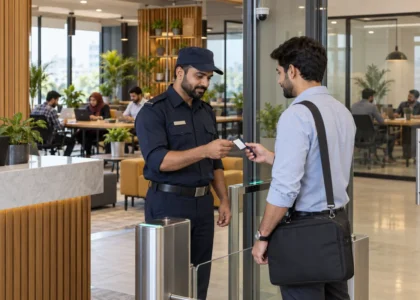

Before a guard takes position at your warehouse, office, school, housing society or event in Lahore, check the company behind the uniform. A professional website and a low monthly rate tell you little about whether an agency is authorized to operate, whether its guards have been vetted, or who will be responsible if an incident occurs.
Hiring a private security company in Lahore involves more than comparing prices and the number of guards available. Businesses should examine company registration, government licensing, insurance coverage, staff verification and the terms of the service agreement before making a decision.
These checks help reduce the risk of hiring an unauthorized provider, deploying poorly screened personnel or facing disputes when something goes wrong.
1. Verify the SECP Company Registration Certificate
Start by confirming that the security provider is a legally registered company. In Pakistan, the Securities and Exchange Commission of Pakistan (SECP) handles company incorporation and maintains corporate registration information.
Ask the provider for its certificate of incorporation and check the following details:
- The complete registered company name.
- The company registration or incorporation details.
- The registered office address, where available.
- Whether the name matches the business issuing your quotation, invoice and contract.
Pay attention to differences between a brand name and a legal company name. A company might advertise under one name while its legal documents use another. That is not automatically a problem, but the provider should explain the relationship and supply supporting documentation.
You can review the SECP company registration guidance to understand the official incorporation process.
Important: Company registration alone does not authorize a business to provide private security services. You must also verify the relevant security agency licence and approvals.
2. Check the Ministry of Interior NOC and Punjab Security Licence
This is one of the most important steps when hiring a private security agency in Lahore.
The Punjab Home Department identifies three key parts of the registration process: federal company registration, a No Objection Certificate (NOC) from the Ministry of Interior, and an operational licence issued by the provincial government through the Home Department. Its guidance also identifies police or Special Branch verification as part of the process.
Ask the company to provide evidence of the applicable approvals, including:
- The Ministry of Interior NOC.
- The Punjab Home Department operating licence.
- The licence issue date and expiry date.
- Any relevant renewal or updated licensing documentation.
Do not rely on a certificate photograph or a claim made by a salesperson. Check the licence number, registered company name and validity. Where details are unclear, contact the issuing authority for confirmation.
The Punjab Home Department’s private security company registration page explains the provincial process and provides access to a list of licensed companies.
Use the latest available list and seek direct confirmation if a provider’s name or licence status does not match. A previous approval or an expired licence should not be treated as proof of current authorization.
3. Ask for Tax and Employer Registration Documents
Tax records and employer registration help you assess whether the provider has established formal business operations.
Request the company’s National Tax Number (NTN) and relevant tax registration details. You can use the FBR IRIS portal to access available online verification services, including taxpayer profile and Active Taxpayer List checks.
Confirm that the tax information belongs to the same legal entity named on the quotation and contract.
You should also ask about employer registration and labour compliance. For example, the Punjab Private Security Companies Regulation and Control Rules, 2003 refer to registration with the Punjab Employees Social Security Institution (PESSI).
Request relevant PESSI registration evidence and, where applicable, EOBI and other employment related records. The documents required for a particular employer can depend on the applicable legislation and circumstances, so confirm the current requirements with the competent authority.
These checks matter because a professional security provider should be able to explain how it employs its guards, maintains staff records and meets its applicable obligations.
4. Verify the Security Company’s Insurance Coverage
Insurance is an important part of evaluating a security contractor. However, not all insurance policies protect against the same risks.
Ask for a copy of the relevant insurance policies or certificates and check the insurer’s identity, policy number, period of coverage, covered personnel, exclusions and claim procedure.
Employee group insurance
The reproduced Punjab Private Security Companies Regulation and Control Rules, 2003 include provisions concerning PESSI registration and group insurance for security company employees. Ask the company to show evidence of its current employee coverage and explain how a claim would be handled if a guard were injured or killed while on duty.
Do not assume that a policy is active simply because a certificate exists. Confirm its validity and coverage with the insurer when necessary.
Public liability and third party cover
Employee insurance is not the same as insurance covering claims involving clients or other members of the public.
Depending on your site and contractual requirements, ask whether the security company carries suitable public liability or third party liability insurance. Clarify what happens if an incident results in injury, damage to property or another covered loss.
The appropriate policy depends on the assignment, contract and risks involved. Do not assume that every type of cover is a universal licensing requirement.
For reference, you can review a reproduced copy of the Punjab Private Security Companies Regulation and Control Rules, 2003. Because legal requirements can change, confirm the current position with the relevant authorities.
5. Check Guard Identity, Background Verification and Training
A security company’s documents are only one part of the picture. The people assigned to your premises also need proper identification, screening and preparation for their duties.
Before deployment, ask the provider to confirm that it maintains the appropriate records for each assigned guard.
These should include:
- A valid company issued identification card with the guard’s identity and photograph.
- Evidence of the required police or antecedent verification.
- Training records or certificates relevant to the role.
- Employment and deployment records.
- Any additional qualifications needed for a specialised assignment.
The Punjab rules address staff verification, guard training, identification and documents carried by security personnel. Ask the company how it checks a guard’s background and what training is provided before deployment.
For example, a guard assigned to a warehouse may need training in access control, visitor registration and incident reporting. Someone working at a hospital or educational institution may need additional preparation for dealing with visitors, emergencies and sensitive situations.
A provider should be able to explain its screening and training process without exposing confidential personal information unnecessarily. Where appropriate, request redacted evidence or written confirmation rather than collecting unnecessary copies of guards’ personal documents.
6. Check Arms Licences and Weapon Authorisation for Armed Guards
If your assignment requires armed security guards, verify the relevant weapons documentation before allowing the deployment to begin.
Ask the provider to demonstrate that the firearms used by its personnel are lawfully held and that each armed guard is authorised to carry the assigned weapon in accordance with the applicable rules.
Depending on the assignment, the relevant records may include:
- Valid arms licensing documentation.
- A company authority letter identifying the guard permitted to carry the weapon.
- Weapon issue and return records.
- Procedures for the custody, storage and handover of weapons.
- Any additional permission required for a particular type of duty.
Check that the documents match the actual guard and weapon being deployed. A general statement that the company owns licensed firearms is not enough to establish that a particular guard is authorised to carry one.
If you need cash in transit or the transportation of valuable items, ask about the additional authorization applicable to that activity. The Punjab rules specifically address authorization for transporting cash or valuable articles.
For an unarmed assignment, focus on the credentials and operational procedures relevant to that service rather than requesting irrelevant weapons documentation.
7. Confirm the Office Address, References and Supervision Arrangements
Paperwork can look convincing while providing little evidence of how a company actually operates. Practical checks help you establish whether the provider has the people and systems needed to manage your site.
Ask for its office address, a responsible contact person and the details of the supervisor who will oversee your guards.
Where possible, visit the office or arrange a meeting with the operations team. Request references from clients with similar requirements and ask specific questions about attendance, replacement arrangements, incident handling and communication.
For example, a factory manager may need a provider that can maintain night shifts, monitor entry and exit points, and arrange a replacement when a guard is absent. A retail business may care more about customer interaction, restricted areas and loss prevention.
The company’s ability to explain these arrangements clearly is a useful indication of how it manages daily operations.
8. Review the Service Agreement Before Making Payment
Never rely entirely on verbal promises. A written agreement should explain what the security company is responsible for and what your business can expect from the service.
Before signing, check that the agreement covers:
- The number of guards, their duties and the working hours.
- The site address and any special security instructions.
- Monthly charges, overtime, taxes and other applicable fees.
- Guard replacement and absence management.
- Supervision, attendance reporting and incident escalation.
- Responsibilities relating to negligence, loss, injury and property damage.
- Insurance responsibilities, termination terms and dispute resolution.
The agreement should identify the correct legal entity and be signed by an authorised representative.
Make sure there is a clear process for reporting incidents and reviewing performance. You should know whom to contact if a guard does not arrive, an access control procedure is ignored or an incident requires urgent attention.
A written agreement cannot prevent every problem, but it reduces the chance of disputes about what each party agreed to provide.
Warning Signs to Watch for Before Hiring a Security Agency
Consider pausing the hiring process if a company refuses reasonable document checks or cannot explain its licensing status.
Other warning signs include an expired or unverifiable licence, inconsistent company names across documents, unclear insurance coverage, guards without proper identification, and a refusal to provide a written service agreement.
Be cautious about unusually low quotations that do not explain staffing, supervision, replacement costs or applicable taxes. A low price does not automatically mean a provider is unreliable, but the company should be able to explain how it will deliver the agreed service at that rate.
Do not make a decision based only on uniforms, a website, online reviews or verbal claims. These can help you compare providers, but they are not substitutes for legal and operational checks.
Final Checklist Before Hiring a Private Security Company in Lahore
Before approving a security provider, make sure you have completed these checks:
- Confirmed the company’s SECP registration and legal name.
- Checked its Ministry of Interior NOC and valid Punjab operating licence.
- Reviewed relevant tax and employer registration records.
- Confirmed applicable employee insurance and assessed other insurance needs.
- Checked guard identification, screening and training arrangements.
- Verified arms documentation if armed guards are required.
- Confirmed the office address, management contacts and supervisory arrangements.
- Signed a written agreement covering responsibilities, costs and incident procedures.
Keep copies of the documents you are entitled to retain and note the relevant expiry dates. For important contracts, repeat the checks when a licence or policy is renewed and whenever the company or service arrangement changes.
Frequently Asked Questions
What is the most important document when hiring a private security company in Lahore?
A valid operating licence from the Punjab Home Department is a key document. You should also verify the company’s SECP registration and Ministry of Interior NOC, rather than treating any single certificate as sufficient proof of compliance.
Does SECP registration mean a security company is legally authorised to operate?
No. SECP registration establishes the company’s corporate registration. The provider must also meet the applicable requirements for operating a private security business, including the relevant government approvals and provincial licence.
Should a private security company provide proof of insurance?
Yes. Ask for evidence of the relevant employee insurance and assess whether separate liability coverage is appropriate for your site and contract. Verify the policy period, covered risks and exclusions before relying on it.
How can a business verify a security company licence in Punjab?
Start with the Punjab Home Department’s private security company registration page and the latest available list of licensed providers. If the information is incomplete or inconsistent, contact the department directly.
What documents should you check for armed security guards?
Check the applicable arms licence, the company’s authorization for the assigned guard, and the relevant weapon custody records. Additional approvals may apply to specialist duties such as cash in transit.
Hire Security Guards in Lahore with BSM Pakistan
Choosing a security provider should start with proper verification, not just a price comparison. Review the company’s legal documents, insurance arrangements, guard credentials and service agreement before making your decision.
If your office, factory, commercial property, residential site or event needs professional security, visit BSM Pakistan to explore our security guard services and discuss the requirements of your site. Ask our team about the relevant company documents, guard verification procedures and service terms before finalising an arrangement.
Make your next security decision with the right questions, the right documents and a clear understanding of the responsibilities involved.
Disclaimer: This article provides general guidance for business owners. Licensing, insurance and employment requirements may change and can depend on the type of service. Confirm applicable requirements directly with the relevant authorities before entering into a contract.