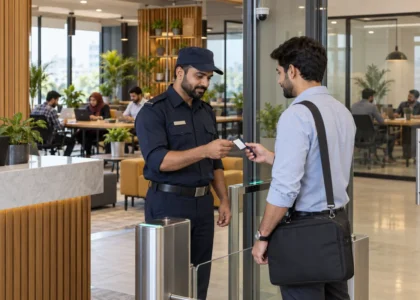

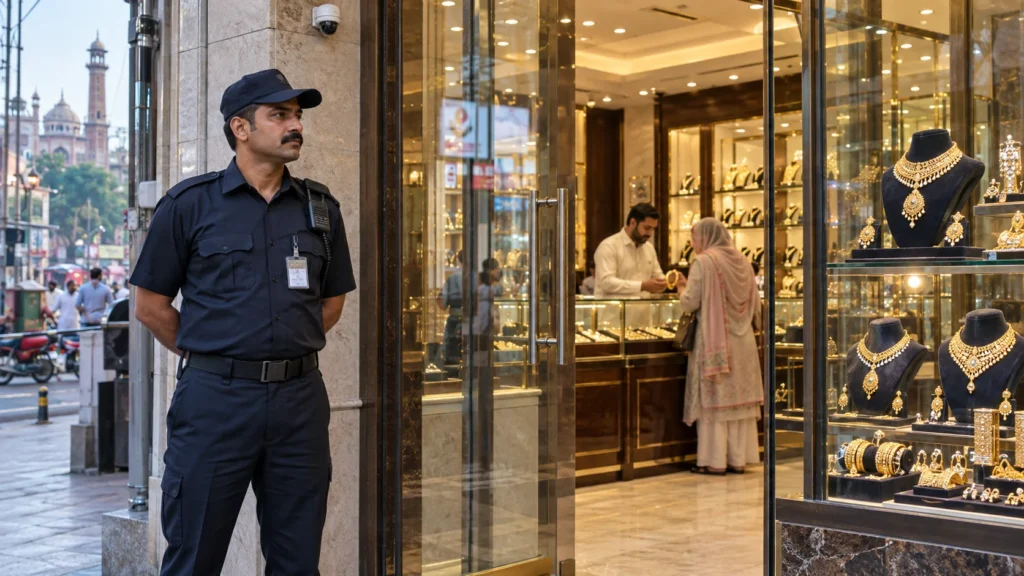
A customer asks to see a necklace. Another family arrives to compare bridal sets. Meanwhile, a supplier is waiting with a delivery and someone needs access to the workshop. For the person behind the counter, several things can demand attention at once.
That is why jewellery shop security needs more than a uniform at the door. Gold, gemstones and finished pieces can hold substantial value in a small space. The guard, sales team and owner need clear responsibilities so that customer service does not leave access or stock movement unattended.
Security guard services for jewellery shops in Lahore should support the way the business actually works: welcoming customers, watching entrances, controlling restricted areas and reporting concerns promptly.
Why Jewellery Shops Need a Specific Security Plan
A jewellery showroom has different needs from an ordinary retail outlet. Pieces are brought out for viewing, moved between counters, accepted for repairs and collected after alterations. Each movement needs an accountable member of staff.
Consider a simple example. A customer brings in a bracelet for repair while a delivery arrives at the entrance. The salesperson should document the bracelet and issue a receipt. The guard should confirm who has authorised the delivery and direct the visitor appropriately. Neither responsibility should disappear because the shop is busy.
A practical plan should address:
- Access to sales areas, workshops and stockrooms.
- Customer activity around display counters.
- Supplier visits, repairs and collections.
- Staff safety during opening and closing.
- Communication when an incident or discrepancy occurs.
The aim is to reduce avoidable gaps while keeping the showroom comfortable for genuine customers.
What Should a Jewellery Shop Security Guard Do?
Monitor the Entrance Without Making Customers Uncomfortable
A guard should welcome visitors respectfully and remain attentive to movement through the entrance. During busy periods, this includes noticing when several arrivals divide the sales team’s attention.
Decisions should be based on behaviour and the shop’s rules. Clothing, appearance or accent should never be treated as evidence of wrongdoing.
If someone requests entry to a private area, the guard should obtain approval from the designated manager. A confident introduction or claim of knowing the owner is not a substitute for authorisation.
Keep Restricted Areas Under Control
Customers, delivery workers and maintenance personnel should not have unrestricted access to workshops, storage rooms or staff areas.
Written instructions should identify who may enter, who can approve exceptions and how temporary access is recorded. Contractors should be directed to the responsible staff member rather than allowed to move through the premises on their own.
Support Checks on Authorised Stock Movement
Security personnel can check that an outward movement has the required approval and paperwork. They should not replace the jeweller’s inventory controls or independently decide the value, weight or authenticity of an item.
Shop staff remain responsible for recording sales, repairs, returns and supplier transactions. The guard’s role is to follow the agreed movement procedure and report missing authorisation.
For example, a repair collection should be released by the authorised employee after the relevant receipt and customer details have been checked.
Protect Display Counters During Customer Visits
Customers need time and space to examine jewellery. The shop also needs a consistent method for keeping track of the pieces being shown.
Sales staff should follow a clear tray handling and item counting procedure. Guards can support this by observing the sales floor and alerting the manager when activity requires attention. They should avoid crowding customers or interrupting normal consultations.
A missing piece or uncertain count should trigger a calm internal check. Staff should inform the manager, preserve relevant records and review footage where available. Public accusations without evidence can harm customers and the business.
Make Opening and Closing Part of the Security Service
The security arrangement should cover preparation and shutdown as well as trading hours. Hiring a guard only for the time customers are inside may leave important duties unassigned.
Before Opening
The responsible staff member and guard should follow a checklist covering:
- Visible signs of damage or interference at access points.
- Unusual conditions that need management review before entry.
- Confirmation that the planned security coverage is present.
- Checks that agreed communication and security systems are working.
Anything unusual should be reported through the shop’s escalation procedure.
Before Closing
Closing checks should confirm that customers and contractors have left, restricted areas are secured and the designated employees have completed stock and cash procedures.
Keys should be issued only to authorised people, with a record of handover where appropriate. If another guard takes over, the outgoing guard should pass on unresolved concerns and relevant instructions.
Keep detailed security arrangements private. They belong in staff procedures, not on a public notice or social media post.
Armed or Unarmed Guards for Jewellery Shops?
The choice should follow an assessment of the premises, operating hours, access points and security requirements.
Unarmed guards can support entrance monitoring, visitor control and reporting. Armed security may be considered where the assessment identifies a need for it. A weapon alone does not make a security arrangement effective. Training, supervision, safe handling and clearly defined responsibilities matter.
If armed coverage is proposed, ask the provider to explain the applicable authorisations and documentation. Discuss the arrangement alongside physical protection, CCTV and alarm provisions rather than treating a guard as the entire solution.
Help Guards and Security Systems Work Together
CCTV can provide a record of events, but the shop needs to know who reviews footage and who responds when a concern is raised.
The same applies to alarms. Management should identify the responsible contact, agree on an escalation procedure and arrange testing with the appropriate system provider. Guards need instructions for reporting a fault, including what happens when normal communication is unavailable.
For an immediate threat, protecting people takes priority. The response plan should emphasise calm communication, appropriate emergency assistance and avoiding unnecessary confrontation. After an incident, relevant footage and records should be preserved for investigation.
Adapt Coverage to Your Lahore Location
A shop on a busy market street may need to coordinate with neighbouring businesses or market management. A showroom inside a mall needs to work with the building’s security team. An independent outlet may have separate responsibilities for its entrance, parking access and staff areas.
Shared security does not automatically cover every duty inside a jewellery shop. Clarify where building security ends and your own arrangement begins.
Review staffing when trading hours change, visitor numbers rise or the layout is altered. A plan that suited a smaller showroom may need adjustment after expansion.
What Affects the Cost of Jewellery Shop Security?
A useful quotation should state what the shop is paying for. Costs depend on the number of posts, coverage hours, armed or unarmed deployment, supervisory arrangements and relief requirements.
Before comparing proposals, ask:
- Which duties and hours are included?
- Who supervises the guard and receives incident reports?
- What happens during breaks, leave or absence?
- How are additional hours or changes to coverage charged?
- What support is available when an urgent concern arises?
The cheapest monthly figure tells you little if the responsibilities are unclear.
Discuss Jewellery Showroom Security With BSM Pakistan
BSM Pakistan provides security guard services in Lahore, including armed and unarmed personnel, onsite guards and professional supervision.
For a jewellery business, the discussion should start with your premises and operating needs. Explain the number of entrances, trading hours, restricted areas and existing security systems. Agree on the duties, reporting contact and coverage before deployment.
Need security guards for your jewellery shop in Lahore? Contact BSM Pakistan to discuss your requirements and request a quotation.
Frequently Asked Questions
Can a small gold shop benefit from a security guard?
Yes. Shop size alone does not determine security needs. Stock value, access, staff numbers and operating hours should all inform the decision.
Is CCTV enough for a jewellery showroom?
CCTV is one part of the arrangement. It needs to work alongside access controls, staff procedures and a defined response when something requires attention.
Should a guard count or value jewellery?
Inventory counting and valuation should remain with authorised shop staff. A guard can support approval checks and report discrepancies within the agreed duties.
Can one guard cover the entrance and every counter?
That depends on the layout and workload. Do not assume one person can monitor separate areas continuously. A site review should establish realistic coverage.
Is overnight security always necessary?
The decision depends on the premises, existing protective measures and assessed needs. Opening, closing and relief coverage should also be included in the discussion.