Factory owners, school administrators and office managers in Lahore ask us some version of the same question: “Should I keep paying for gate guards, or just put in card readers and be done with it?”
It’s a fair question. Electronic access control systems have become cheaper and far more common in Lahore. Fingerprint machines that once sat only in bank branches now hang at the entrance of garment units, schools and software houses in Johar Town. So it’s natural to wonder whether a trained access control guard is still worth the monthly cost.
The short answer: when it comes to access control guards vs electronic access control, most businesses in Pakistan shouldn’t pick one over the other. A machine checks credentials. A guard checks people. You usually need both, in the right proportion for your site.
The longer answer depends on your building, your staff count, your visitor traffic, and how much risk you carry. Below, we break down what each option really does, where each one fails, and how to work out the right mix for your business. We’ll keep it practical, based on what we see on client sites across Lahore and Punjab.
What Does an Access Control Guard Actually Do?
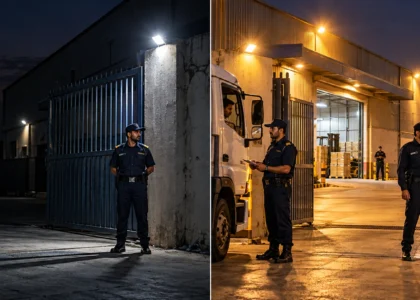
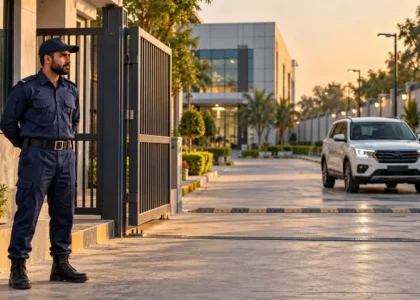
An access control guard is a trained security officer posted at an entry point to decide who gets in, who doesn’t, and what goes in or out with them. It sounds simple. Done properly, it isn’t.
On a typical shift, a good access control guard will:
- Verify staff identity cards and match faces to names, not just glance at a lanyard
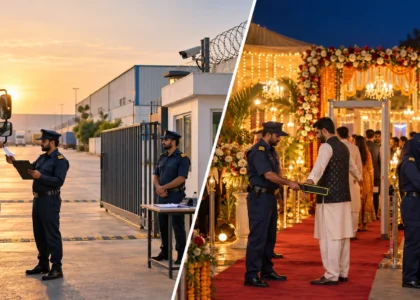
- Register visitors, confirm the host is expecting them, and issue visitor passes
- Check vehicles entering and leaving, including boots and goods carriers
- Inspect bags and material gate passes to stop pilferage of stock, tools and raw material
- Stop tailgating, where an outsider walks in behind an authorised person
- Handle deliveries, contractors and daily wage labour without letting the gate turn into a free-for-all
- Keep a written or digital log that management can review later
- Respond on the spot when something feels wrong, and escalate to a supervisor
The last point is the one that matters most. A guard can read body language, notice that a “courier” has no parcel, or remember that the man claiming to be a new electrician was turned away last week. That kind of judgement is what you’re paying for.
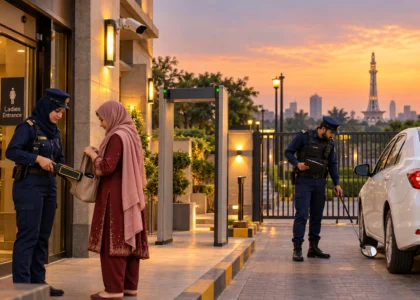
At Bulwark Security & Management Pakistan, access control is a core part of our unarmed security guard services. For sites that need it, we also deploy female guards for checking women visitors and staff, which is a practical requirement at schools, hospitals and many offices in Pakistan.
What Is an Electronic Access Control System?
An electronic access control system uses hardware and software to lock or unlock doors, gates and barriers based on a stored credential. Instead of a person deciding, the system checks whether your card, fingerprint, face or PIN is on the approved list.
The most common setups we see in Pakistani businesses are:
- Biometric fingerprint terminals, often doubling as staff attendance machines
- Face recognition readers, increasingly popular since they’re touch-free
- RFID card or key fob readers on office doors and server rooms
- Turnstiles and flap barriers at lobbies of larger offices and plazas
- Boom barriers with ANPR cameras at car parks and housing society gates
- Keypad locks on store rooms and cash rooms
The real strength of these systems is consistency and records. They don’t get tired at 3 a.m., they don’t do favours for a cousin, and every entry is time-stamped. You can restrict the finance office to five people, cancel a resigned employee’s card in seconds, and pull a report showing who opened the warehouse on Sunday.
But a system only knows about the credential. It has no idea who is holding the card, or whether the person with a valid fingerprint is walking out with a carton of your stock.
Access Control Guards vs Electronic Systems: Side-by-Side Comparison
Here’s how the two compare on the factors business owners in Lahore usually care about.
| Factor | Access Control Guard | Electronic Access Control System |
|---|---|---|
| Upfront cost | Low. No hardware to buy | Medium to high: readers, locks, wiring, software, installation |
| Running cost | Monthly salary or contract fee | Maintenance, repairs, power backup, software support |
| Judgement and discretion | Strong. Can question, observe and decide | None. Accepts any valid credential |
| Visitors, vendors and labour | Handles them well | Weak unless someone issues and manages temporary credentials |
| Tailgating | Can stop it on the spot | Easily defeated unless paired with turnstiles or a guard |
| Material and vehicle checks | Yes: bags, vehicles, gate passes | No |
| Audit trail | Manual or semi-digital logs | Automatic, time-stamped and searchable |
| Consistency | Depends on training and supervision | Same rule every time |
| Power outages | Not affected | Needs UPS or battery backup to stay secure |
| Emergencies (fire, fights, medical) | Can act, guide people and call for help | Can release doors, but can’t respond |
| Scalability for many doors | Costly to post a guard at every door | Easy to add readers to internal doors |
| Deterrence | Visible presence discourages attempts | Limited on its own |
The pattern is clear. Guards are strong wherever people, judgement and physical checks are involved. Electronic systems are strong wherever you need records, rules and coverage across many doors.
Where Access Control Guards Win
When your gate sees a lot of outsiders. Factories, construction sites and warehouses deal with drivers, suppliers, contractors and daily wage workers all day. Issuing cards to all of them isn’t realistic. A guard can verify, register and escort.
When theft walks out, not in. Much of the loss on industrial and construction sites is internal: material slipping out in a vehicle or a bag. A biometric reader will happily let a thief clock out. Only a physical check at the gate stops it.
When the power goes. Load-shedding and voltage drops are still part of life across Punjab. A magnetic lock without proper backup either fails open (anyone walks in) or fails closed (staff are stuck). A guard keeps working in the dark.
When a situation needs a human. An angry ex-employee at reception, a medical emergency in the lobby, a crowd at an event gate. Machines don’t de-escalate. Trained people do.
When you need visible deterrence. Most opportunistic criminals pick the easier target. A uniformed, alert guard at the gate tells them your site isn’t it.
Where Electronic Access Control Systems Win
When you have many internal doors. Posting a guard outside the server room, the cash office, the store and the HR office isn’t practical. Readers on those doors are.
When you need records you can trust. Electronic logs are hard to fake and easy to search. If something goes missing, you can see exactly whose credential opened that door and when.
When access rules change often. Staff join, leave and move departments. With a system, you add or cancel access in minutes, without re-briefing every guard on every shift.
When the building runs after hours. Software houses and BPOs with night shifts can let authorised staff in at 2 a.m. without anyone manually checking every entry.
When you want to reduce guard fatigue. Machines take care of routine staff entry, so your guards can focus on visitors, vehicles, patrols and anything unusual.
The Hybrid Approach: Why Most Businesses Need Both
The businesses that get access control right rarely pick a side. They layer it.
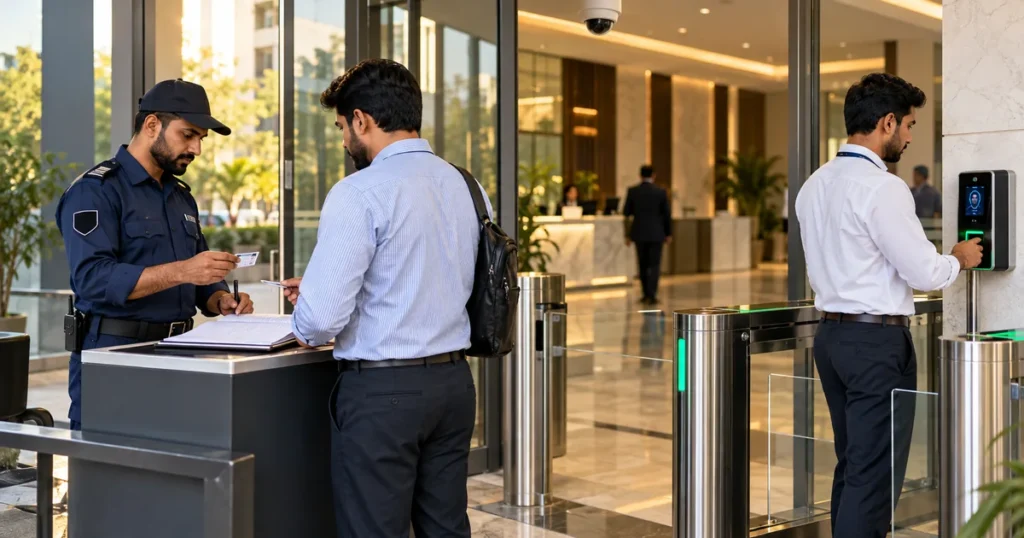
A common setup looks like this: a trained guard at the main gate handles vehicles, visitors, deliveries and bag checks. Staff badge or scan in through a reader or turnstile just behind the guard post. Sensitive internal rooms have their own readers. CCTV covers the entrance, and the guard keeps an eye on it. The supervisor reviews both the guard’s register and the system’s logs every week.
Each layer covers the other’s blind spot. The system catches what a tired guard might miss on a busy morning. The guard catches what the system can’t see: the borrowed card, the tailgater, the full bag.
One point that often gets overlooked: someone still has to manage the system. Readers need cleaning, cards get lost, fingerprints fail for workers with worn hands, and the visitor queue builds up when the reader hangs. A trained access control guard who knows how to operate your system makes the technology actually work.
Which Option Suits Your Business?
Every site is different, but this is a sensible starting point by business type.
| Business type | Recommended approach | Why |
|---|---|---|
| Factories and industrial units | Guards at gates + biometric for staff | High vehicle and labour traffic; material theft risk |
| Construction sites | Guards, with day and night shifts | Changing workforce and open boundaries make systems impractical |
| Warehouses and godowns | Guards at loading gates + readers on stores | Goods movement needs physical checking |
| Corporate offices and software houses | Turnstiles or readers + reception guard | Mostly staff traffic; visitors still need screening |
| Banks and cash-handling businesses | Armed guards + strict electronic control | High risk calls for both deterrence and records |
| Schools, colleges and hospitals | Male and female guards + visitor system | Large numbers of visitors and parents; female checking needed |
| Housing societies | Guards at gates + boom barriers or vehicle stickers | Residents, guests, domestic staff and deliveries all day |
| Small shops and clinics | A single guard or a keypad lock with CCTV | Budget-friendly coverage for a single entry |
If your business sits in the first three rows, guards are not optional. If you’re closer to the corporate end, technology can carry more of the load, but someone still needs to own the front door. For gated communities, our housing society security services are built around exactly this mix.
6 Questions to Ask Before You Decide
Before you spend on hardware or sign a guarding contract, sit down with these:
- How many people pass through your entrances daily, and how many are not your staff? The more outsiders, the more you need guards.
- What are you actually trying to protect? People, cash, stock, data, or reputation. Each points to a different setup.
- Where has loss or trouble happened before? Past incidents are the best guide to your weak points.
- How many doors and gates need control? One gate suits a guard. Twelve internal doors suit a system.
- What happens to your setup during a power cut? If the honest answer is “we’re not sure”, fix that first.
- Who will manage and review it? A system nobody checks and a guard nobody supervises are both just decorations.
If you’d like a second opinion, our team can visit your site, walk your entry points with you and suggest a guarding plan that works alongside whatever technology you already have. No sales pressure, just a practical assessment.
Need trained access control guards for your business in Lahore or Punjab? Visit Bulwark Security & Management Pakistan to see our services, or call us on 042-35919699 / WhatsApp 0302-1974444 to book a site security consultation.
Frequently Asked Questions
Can an electronic access control system completely replace security guards?
For a small office with only staff traffic, it can handle most routine entry. For factories, warehouses, construction sites, schools and housing societies, no. Someone still has to deal with visitors, vehicles, deliveries, bag checks and emergencies.
Are access control guards cheaper than electronic systems?
Guards have almost no upfront cost but a monthly fee. Systems cost more at the start, then need maintenance and backup power. For a single gate, a guard is usually the more cost-effective choice. For many internal doors, a system is.
What is tailgating, and how do you stop it?
Tailgating is when an unauthorised person follows an authorised one through a door before it closes. Turnstiles reduce it, but a trained guard watching the entrance is the most reliable way to stop it.
Do biometric attendance machines count as access control?
Only if they’re connected to a lock, barrier or turnstile. A machine that just records attendance tells you who came in. It doesn’t stop anyone.
What should a good access control guard be trained in?
ID verification, visitor registration, vehicle and bag searches, gate pass procedures, handling difficult people politely, basic first aid, fire evacuation, and how to operate any electronic system on site.
Do you provide access control guards outside Lahore?
Yes. Bulwark Security provides guards in Lahore and nearby cities including Gujranwala, Sialkot, Kasur, Narowal and Pattoki.