Most business owners hiring security face the same question: is one guard enough, or do I need more?
Fair question. Guards are a monthly cost, and nobody wants to pay for people standing around. But under-staffing carries its own risk. A large warehouse with a single night watchman leaves long stretches of boundary wall unwatched, and a shop with one guard is unattended every time he steps away for a meal or namaz.
So here’s the honest version. Choosing between one security guard vs multiple security guards has very little to do with how big or important your business is. It comes down to three things: how many places need eyes at the same time, for how many hours, and what happens when the one person on duty is busy, on a break, or in trouble.
This guide walks through how we think about it at Bulwark Security & Management Pakistan, so you can make the call yourself before you speak to any security company in Lahore.
The Short Answer
One trained guard is usually enough when you have a single entrance, fixed daytime hours, low-value stock on site, and help close by.
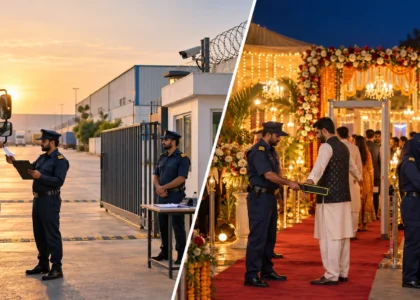
You need multiple security guards when you run 24/7, have more than one gate or a long perimeter, keep cash or valuable goods on the premises, deal with heavy visitor or vehicle traffic, or need someone to patrol while someone else holds the gate.
If two or more items from that second list describe your site, a single guard is almost certainly leaving gaps you can’t see from the front door.
When One Security Guard Is Enough
A single guard does well where the job is mostly access control at one point. Typical examples:
- A small office or clinic with one main door, open 9 to 6
- A boutique or showroom in a market, where neighbouring shops and the market’s own chowkidars add a second layer
- A house with a boundary wall, one gate and working CCTV
- A small godown that only needs someone present during loading hours
What these sites share is simple. One way in, a short or fixed schedule, and people nearby. The guard can see everything that matters from one spot, and if something goes wrong, help is within shouting distance.
Even then, a one-guard post only works when a few basics are in place:
- A way to raise the alarm. A phone with emergency numbers saved, a panic button, or a direct line to the security company’s supervisor.
- Break cover. Someone, whether a staff member or a relief guard, who watches the door during meals and prayer.
- Written duties. Who gets in, what gets checked, what goes in the register.
- Supervisor visits. Unannounced checks, so the post doesn’t slowly go to sleep.
A lone guard with no backup, no break cover and no supervision isn’t really a security plan. He’s a uniform at the door.
When You Need Multiple Security Guards
The case for a team gets strong the moment one person physically can’t cover the ground. These are the situations where we almost always recommend two or more guards.
You operate around the clock
Nobody stays alert for 24 hours. A 24/7 site needs guards working in shifts, which means more than one person on the roster even if only one is on duty at a time. The shift math further down shows exactly how many.
There’s more than one way in
A main gate, a staff entrance and a loading bay are three separate problems. A guard at the main gate can’t stop someone walking in through the back.
The perimeter is long
Factories in Sundar Industrial Estate or Quaid-e-Azam Industrial Estate, construction sites and warehouses usually have long boundary walls and dark corners. Most theft at these sites happens far from the gate, over a wall or through a back shutter. One guard holds the gate while another patrols.
Cash, stock or costly equipment is on site
Banks, jewellers, petrol pumps, pharma warehouses and electronics stores are obvious targets. Here the question isn’t just coverage, it’s response. A lone guard is easy to overpower or distract. Two guards, with at least one armed security guard where the threat calls for it, change the math for anyone planning a robbery.
Heavy footfall or vehicle traffic
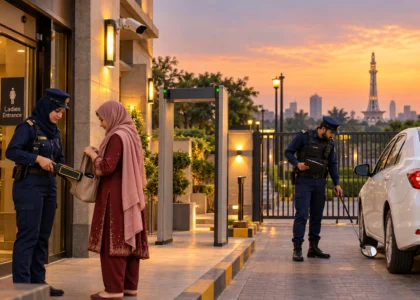
Hospitals, schools, factories at shift change and housing society gates can see hundreds of entries an hour. A guard checking a car boot can’t also watch the pedestrian gate. Many of these sites also need a female security guard to check women visitors properly and respectfully.
You need someone to respond, not just be present
If an alarm goes off at the back of the building, someone has to go and look. With one guard, going to look means leaving the gate unattended. With two, one investigates while the other holds position and calls for backup.
One Guard vs a Team: Side-by-Side
| Factor | One security guard | Multiple security guards |
|---|---|---|
| Area covered | One point, one direction | Gate, patrol route and backup |
| Meal and prayer breaks | Post is empty unless someone covers | Covered within the team |
| 24/7 operation | Not realistic | Rotating day and night shifts |
| Responding to an alarm | Must leave the post | One responds, one holds the post |
| If the guard is ill, hurt or overpowered | Site is unprotected | The others raise the alarm |
| Monthly cost | Lowest | Higher, grows with posts and shifts |
| Alertness and supervision | Hard to check | Guards keep each other sharp; shift supervisor possible |
| Best suited to | Small offices, shops, homes, daytime sites | Factories, warehouses, banks, hospitals, schools, societies, construction sites, events |
Still weighing it up? Every site is different. Speak to Bulwark Security & Management Pakistan and we’ll help you work out the right number of guards for your property.
How Many Security Guards Do I Need? Five Questions to Answer First
Take a walk around your property while you go through these. It takes about twenty minutes and will tell you more than any sales pitch.
- How many ways can someone get in? Count every gate, door, shutter, roof access and low section of wall. Each active entry point usually needs its own post, or at least a camera plus a patrol route.
- How many hours a day does the site need protecting? Business hours only, business hours plus the night, or 24/7?
- What would a thief want here, and what is it worth? Cash, copper cable, finished goods, vehicles, records, or people. Higher value means more guards, and possibly armed ones.
- How many people and vehicles come and go? A quiet office and a factory at shift change need very different manning.
- If your guard needs help, how long until it arrives? If the honest answer is more than five minutes, a second guard on site is your backup.
Now look at your answers. One entry, daytime only, low value, light traffic and help nearby all point to one guard. Anything beyond that points to a team, or at least a second post at night.
Shift Math: Why 24/7 Security Takes More Than One Guard
This is where a lot of people get caught out. You want one post covered around the clock, so it sounds like one guard. It isn’t.
A week has 168 hours. Most guards in Pakistan work 12-hour shifts, six days a week, which comes to 72 hours. Run the numbers and it looks like this:
| What you want covered | Shift length | Guards on the roster |
|---|---|---|
| 1 post, 24/7 | 12 hours | 2 guards plus a relief guard for weekly offs (168 ÷ 72 = 2.3) |
| 1 post, 24/7 | 8 hours | 4 guards (168 ÷ 48 = 3.5) |
| 2 posts (gate + patrol), 24/7 | 12 hours | About 5 guards |
| 1 post, night only (8 p.m. to 8 a.m.) | 12 hours | 1 guard plus relief cover one night a week |
Hire one person and ask him to manage both day and night, and you’ll have a guard asleep by 2 a.m. That’s not a discipline problem. It’s arithmetic.
Shorter shifts cost more per post but keep guards sharper, which matters most at night and at high-risk sites. Any professional security guard company should be able to show you the duty roster on paper before you sign.
Typical Security Guard Deployment by Business Type
These are general starting points, not fixed rules. Your layout, location and history of incidents can push the number up or down.
| Business type | Typical deployment | Why |
|---|---|---|
| Small office or clinic (daytime) | 1 unarmed guard | One door, staff around, short hours |
| Retail shop or showroom | 1 guard by day; 1 to 2 at night if stock stays inside | Break-ins usually happen after closing |
| House or farmhouse | 1 guard by day, 1 by night, plus relief | The family is home and asleep at night |
| Construction site | 2 or more per shift: gate plus patrol | Material is spread across open ground |
| Factory or warehouse | 2 to 4 per shift: gate, patrol, loading bay | Several entry points and high-value stock |
| Bank, jeweller or petrol pump | At least 2, including an armed guard | Cash on site and robbery risk |
| Hospital or school | Several posts, including female guards | Heavy footfall and women visitors |
| Housing society | A guard at each gate, mobile patrol, shift supervisor | Many gates spread over a large area |
| Event or wedding | Based on crowd size, entrances and VIP guests | Entry checks, parking and crowd flow |
If your business sits between two rows, go with the higher one for night shifts. Night is when the gaps get used.
Common Mistakes Businesses Make
- Starting from the budget instead of the risk. “I can afford one” is how blind spots begin. If money is tight, pair one guard with CCTV and proper lighting rather than pretending one person sees everything.
- Forgetting breaks, leave and sick days. Every guard eats, prays and occasionally falls ill. Without relief cover, your post is empty more often than you’d guess.
- Putting every guard at the front. Thieves rarely use the main gate. Back walls, rooftops and loading areas need attention too.
- Getting armed vs unarmed wrong. Armed guards bring licensing, extra training and more responsibility. Use them where the threat justifies it, not as a status symbol.
- Adding guards without supervision. Three unsupervised guards can do less than one well-supervised one. Ask how often the company’s supervisors visit, day and night.
- Never revisiting the setup. A new wing, Ramadan timings, wedding season or a theft on your street are all good reasons to review how many guards you have.
What a Good Deployment Plan Should Include
Before you agree on a number of guards with any security company, check that the plan covers these four things:
- A post plan showing where each guard stands or patrols and what each one is responsible for
- A shift roster that accounts for breaks, weekly offs and leave
- The right type of guard for each post: armed, unarmed, female or onsite
- Supervision, with regular checks and clear reporting back to you
Bulwark Security & Management Pakistan offers customized security planning, and every guard works under professional supervision with clear reporting and accountability. For a small, low-risk site, one well-trained and well-supervised guard can be the right answer. Larger or higher-risk sites need a team.
Not sure how many guards your business needs?
Bulwark Security & Management Pakistan provides trained, supervised security guard services in Lahore for offices, factories, shops, homes, societies and events. Tell us about your site and we’ll recommend a deployment that fits your property, your hours and your budget.
Get your security plan from Bulwark Security →
Call 042-35919699 · WhatsApp 0302-1974444
We also cover nearby cities, including Gujranwala, Sialkot, Kasur, Narowal and Pattoki.
Frequently Asked Questions
Is one security guard enough for a small business?
Often, yes, if you have one entrance, work daytime hours and keep little of value on site overnight. Make sure the guard has a way to call for help and someone covers his breaks.
How many security guards do I need for 24/7 coverage?
For a single post on 12-hour shifts, plan on two guards plus a relief guard for weekly offs. On 8-hour shifts, you’ll need four. Every extra post roughly doubles that.
Can CCTV replace a second security guard?
CCTV helps you see more, but it can’t stop anyone. Cameras work best alongside a guard, and someone still has to watch the screens and respond. For a low-risk site, one guard plus good cameras can be a sensible middle ground.
Should I hire armed or unarmed security guards?
Unarmed guards suit most offices, shops, homes and schools. Armed guards make sense where there’s cash, high-value stock or a real robbery risk, such as banks, jewellers and some factories.
How many security guards does a factory or warehouse need?
Most need at least two per shift, one at the gate and one on patrol, with more for loading bays or a long boundary. A site visit is the only reliable way to set the number.
How quickly can a security company deploy guards in Lahore?
It depends on the number of guards and the type of post. Contact our team with your requirements to discuss timelines.