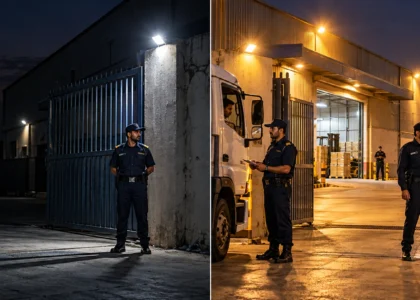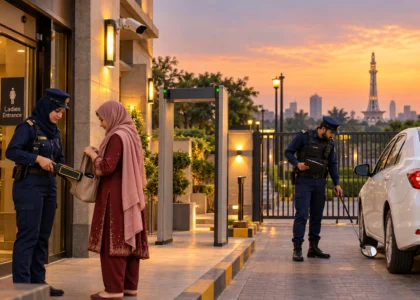

Imagine a factory owner on Ferozpur Road whose regular watchman has gone back to his village for two weeks. Stock is arriving on Monday, and he needs two guards, just for now. Now picture a wedding planner in DHA with a very different need: eight guards for one night, a separate entry for ladies, and someone to keep the parking under control.
Both are reasonable needs. But they point to a question many business owners in Lahore never stop to ask: should you sign a monthly security contract, or hire guards only when you need them?
The honest answer is that it depends on how your business actually runs. A monthly contract gives you the same trained guards, proper supervision and predictable billing. Short-term security gives you flexibility for events, gaps and one-off risks. Pick the wrong one and you either pay for coverage you don’t need or leave your premises exposed at exactly the wrong moment.
This guide walks through how each arrangement works, what it really costs, where each one makes sense, and the questions to ask before you sign anything.
What Is a Monthly Security Contract?
A monthly security contract is an ongoing agreement where a security company deploys guards at your site for fixed shifts, and you pay a set fee every month. It usually runs for a minimum period, often six months or a year, and renews unless either side gives notice.
The guards are employed by the security company, not by you. That matters more than people think. Their salary, leave, uniforms, EOBI and social security contributions, training and replacements are the company’s responsibility. You deal with one invoice and one point of contact.
A well-written monthly agreement normally covers:
- Number of guards, armed or unarmed, and the posts they will hold.
- Shift timings, whether 8-hour or 12-hour, and who covers weekly offs.
- Supervision visits and how often a supervisor checks the site.
- Replacement guards when someone is sick, on leave or not performing.
- Duties at each post, such as the visitor register, vehicle checks and key control.
- Incident reporting and who you call at 2 a.m. if something goes wrong.
- Notice period and how the contract can be ended.
The real value of a monthly arrangement isn’t just a guard at the gate. It’s continuity. The same guard learns which supplier comes on Tuesdays, which employee always forgets his card, and which car has no business being in the parking lot. That kind of site knowledge takes weeks to build and is lost every time you change faces.
What Is a Short-Term Security Arrangement?
Short-term security means hiring guards for a defined, limited period. That could be a single evening, a weekend, a few days or a few weeks. Billing is usually per guard, per shift or per day, and the arrangement ends when the job does.
In Lahore, short-term security is commonly used for:
- Weddings and family functions in marquees, farmhouses and banquet halls, especially during the winter wedding season.
- Corporate events, launches and exhibitions, where entry points and crowd flow need managing for a day or two.
- Temporary gaps, such as when an in-house guard is on leave or a previous security provider has walked off.
- High-risk windows, like moving cash or stock, a dispute with former employees, or a site shutdown.
- Short projects, for example a renovation, a store fit-out or the first weeks of a construction job before a long-term plan is in place.
- Seasonal peaks, including the Ramzan and Eid shopping rush when retail footfall jumps.
Short-term security is genuinely useful. The catch is that the guard who shows up has probably never seen your site before. Everything depends on how well the company briefs that guard and how clearly you explain what you need.
Monthly Security Contract vs Short-Term Security: Side by Side
Here is how the two arrangements compare on the points that matter most to business owners.
| Factor | Monthly security contract | Short-term security arrangement |
|---|---|---|
| Commitment | Minimum term, usually with a notice period | Ends when the event or need ends |
| Billing | Fixed monthly fee | Per guard, per shift or per day |
| Cost per guard-day | Generally lower | Generally higher |
| Guard familiarity with site | Builds over weeks | Starts from zero |
| Supervision | Regular, scheduled visits | Mostly limited to the deployment |
| Replacements and leave cover | Built into the contract | Depends on the provider’s spare staff |
| Setup time | Planned site survey and deployment | Can be arranged quickly, with notice |
| Flexibility | Changes need agreement | Scale up or down per booking |
| Best for | Ongoing premises with daily activity | Events, gaps and temporary risks |
Neither column wins outright. A monthly contract is cheaper per day and stronger on accountability. Short-term hiring is easier to start and stop. The question is which set of trade-offs fits your site.
When a Monthly Security Contract Is the Better Choice
If your premises are open, stocked or occupied most days of the month, a monthly contract almost always works out better. A few common examples:
Factories, warehouses and industrial units
A unit in Sundar or Quaid-e-Azam Industrial Estate has trucks coming and going, contract labour changing shifts and stock that is easy to walk out with. The gate guard needs to know the regular drivers, the dispatch routine and which gate passes are genuine. You only get that with the same people on post every day.
Offices, banks and corporate buildings
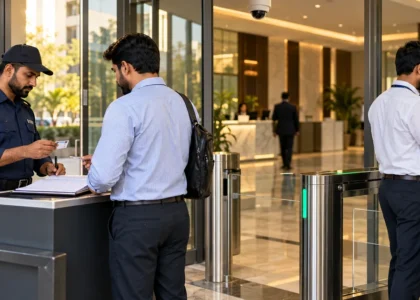
Visitor control is a daily job. A guard who knows your staff by face spots an outsider in seconds. Companies with compliance or audit requirements also need documented, consistent security arrangements, which a monthly contract provides.
Housing societies and residential buildings
Residents expect to see familiar faces at the gate. They also expect the guard to remember that the cook leaves at 9 and the plumber has been told not to come back. If you manage a society, our guide on preparing a security plan for a large residential community goes into posts and shift planning in more detail.
Schools, hospitals and clinics
These sites deal with children, patients, anxious families and sometimes tense situations. Many also need female security guards at certain entry points. Trust and routine matter here, and that comes from a stable team.
Construction sites running for months
Material theft on construction sites rarely happens on day one. It happens in month three, once someone has figured out when the gate is unattended. Continuous coverage from known guards closes that window.
A simple rule of thumb: if you would need guards for more than 15 to 20 days in a month, get a monthly quote. Daily rates add up quickly, and you lose the supervision and replacement guarantees that come with a contract.
When Short-Term Security Makes More Sense
Short-term hiring is the right call when the risk has a clear start and end date. Signing a six-month contract for a three-day exhibition makes no sense.
Events and functions. A mehndi at a farmhouse in Bedian Road, a product launch at a Gulberg hotel or a stall at Expo Centre Lahore all need guards who can handle crowds, gate-crashers, parking and VIP arrivals, but only for those hours. Book event security guards for the event itself, and ask for a short site walk-through beforehand.
Covering a gap. Your in-house guard is on leave, or you have just ended a contract with an unreliable provider. Short-term cover keeps the gate manned while you sort out a long-term plan.
A specific threat or sensitive period. Moving premises, transferring valuables, closing a branch, or a known dispute can all raise risk for a few days. Extra guards, or armed guards where the situation calls for it, can be added for that window only.
Testing a provider. Some businesses book a company for a short job first to see how its guards turn up, dress and behave before committing to a monthly arrangement. It’s a sensible approach, as long as you remember that a one-night event won’t show you how the company handles supervision and replacements over months.
One caution: “short-term” should never mean “last-minute and unchecked.” A guard sent at two hours’ notice with no briefing is a body in a uniform, not security. Give your provider as much notice as you can, and share the guest count, entry points and any specific concerns in advance.
Cost: What You’re Really Paying For
Most people compare the headline rate and stop there. That’s where the mistakes happen.
What drives the price of either arrangement
- Armed or unarmed guards, and whether licensed weapons are needed.
- Shift length and whether coverage is day only, night only or 24 hours.
- Number of posts and how many guards each post needs across shifts.
- Supervision, reporting and any equipment such as radios or metal detectors.
- Location, travel and, for events, late-night drop-off of guards.
Why monthly usually costs less per day
When a company knows it will deploy a guard for a full month, it can plan rosters, pay the guard a stable salary and spread its overheads. With short-term work, the company has to keep spare guards available, arrange transport and absorb the cost of bookings that get cancelled. That shows up in the daily rate.
The hidden costs of going cheap
A quote that looks much lower than everyone else’s is rarely a bargain. Often it means the guard is underpaid, untrained, or not registered for EOBI and social security. Underpaid guards leave quickly, sleep on night shift, or simply don’t show up. On short-term jobs, it can mean the company is sending whoever happens to be free.
More often than not, the expensive incident is almost never the security bill. It’s the stolen copper cable, the gate-crasher who starts a fight at a wedding, or the empty post on the one night it mattered. Before you accept any quote, check the company’s paperwork. Our post on documents to verify before hiring a private security company in Lahore lists exactly what to ask for.
Want a straight comparison for your own site? Bulwark Security & Management Pakistan quotes both monthly and short-term arrangements, so you can see the numbers side by side. Request a quote from our home page.
The Middle Ground: A Monthly Base With Short-Term Top-Ups
For a lot of businesses, the smartest setup isn’t one or the other. It’s both.
For example, picture a mid-sized retail outlet on MM Alam Road. Two guards on a monthly contract handle the entrance and back door all year. During the last ten days of Ramzan and the Eid rush, footfall triples, so two more guards are added for those weeks only. Because the extra guards come from the same company, the regular team can brief them on the store’s layout and routine on day one.
The same logic works for:
- Factories that add night guards during peak production or when high-value stock arrives.
- Housing societies that bring in extra guards for Independence Day, Muharram processions on nearby routes, or a society event.
- Farmhouses that keep one caretaker-guard on a monthly basis and add a team for weddings and large gatherings. We’ve covered this in our farmhouse security guide.
If you go this route, write the top-up terms into your monthly agreement upfront: how much notice you need to give, the rate for additional guards, and who supervises them. That saves you from negotiating in a hurry when you need guards tomorrow.
The choice between fixed and periodic coverage is closely related to the static versus patrol question too. If you’re weighing that up as well, read our comparison of static security guards and mobile patrol security.
Questions to Ask Before You Sign Either Agreement
Whichever way you lean, put these questions to the security company and get the answers in writing.
For a monthly security contract:
- What is the minimum term and the notice period to end it?
- How often will a supervisor visit, and will I get a report?
- If a guard is absent, how quickly is a replacement sent, and is there any extra charge?
- Can I ask for a guard to be changed if I’m not satisfied?
- Are the guards registered for EOBI and social security, and is their salary paid on time?
- Does the rate change after a year, and on what basis?
For short-term or event security:
- How much notice do you need, and what happens if I cancel?
- Will the guards visit the venue or get a briefing before the event?
- Who is the team lead on site, and what is their number?
- Is the rate per shift, per day or per hour, and are overtime and transport included?
- Can you provide female guards for ladies’ entry and checking?
A professional company will answer these without hesitation. If you get vague replies, or the answer to everything is “don’t worry, sir,” take that as your answer.
Frequently Asked Questions
Is a monthly security contract cheaper than hiring guards daily?
Per day, yes, in most cases. A monthly contract lets the company plan rosters and spread its costs, so the effective daily rate is usually lower. If you need guards for most of the month, a monthly arrangement will normally cost less overall.
Can I hire security guards for just one day in Lahore?
Yes. Single-day and single-night bookings are common for weddings, corporate events and exhibitions. Give the company enough notice to arrange trained guards and, ideally, a short visit to the venue beforehand.
What is the usual minimum term for a monthly security contract?
It varies by company and site. Many agreements run for six or twelve months with a one-month notice period, but terms are often negotiable. Read the termination clause carefully before you sign.
Are short-term security guards as well trained as contract guards?
They can be, if they come from a properly run company that trains all its staff. The difference is site knowledge. A short-term guard has to learn your premises quickly, so a good briefing makes a big difference.
Can I switch from short-term security to a monthly contract later?
Yes, and it’s a sensible path. Starting with a short booking lets you see how a company’s guards perform. If you’re happy, you can move to a monthly security contract and often keep the same guards on post.
Do I need armed guards for an event or a short assignment?
Not always. Most events are well served by trained unarmed guards for access control and crowd management. Armed guards make sense where there is cash, valuables, VIP movement or a specific threat. Discuss the risk with your provider before deciding.
So, Which Is Right for Your Business?
If your site is active most of the month, choose a monthly security contract. You get lower daily costs, guards who know your premises, regular supervision and someone accountable when things go wrong.
If the risk is tied to a date, such as an event, a gap in cover or a short project, short-term security is the practical choice. Just don’t treat it as an afterthought.
And if your needs rise and fall through the year, combine the two: a steady monthly team with extra guards added when you need them.
Not sure where your business fits? That’s a normal place to start. Tell us about your site, your hours and what worries you, and we’ll suggest an arrangement that matches your risk and your budget, whether that’s a single night or a long-term team.
Talk to Bulwark Security & Management Pakistan today and get the right security coverage for your business in Lahore and across Punjab.
Prefer to speak directly? Call 042-35919699 or WhatsApp 0302-1974444, or visit our contact page.